The New Zealand dollar declined against the Aussie in the Asian session yesterday following the report of a wider than anticipated trade deficit for September. The slightly better than anticipated trimmed mean CPI data from Australia enabled the Aussie to consolidate its gains for the rest of the day. Overall, the AUD/NZD pair rose to a high of 1.0515 from a low of 1.0470 in the past 24 hours.
According to data published by Statistics New Zealand, the trade deficit narrowed to N$2.171 billion in September, from N$2.139 billion in the prior month, and disappointed economists who were anticipating a sharp decline in the trade deficit to N$762 million.
On a y-o-y basis, goods exports increased 10% (or N$387 million) to N$4.40 billion in September 2021. Likewise, goods imports grew by 30% (or N$1.50 billion) to N$6.60 billion.
Goods exports for the year ended September 2021 were N$62 billion, an increase of 2.10% (or N$1.20 billion) from last year. Similarly, goods imports for the year ended September 2021 were N$66 billion, reflecting a growth of 12% (or N$7 billion) on a y-o-y basis.
Data published by ANZ indicates that the business confidence index slipped further to -13.40 in October, from 8.60 in September. However, the index reflecting expectations for own trading activity remained strong at 21.70, albeit a slight dip from 26.20 recorded in September.
Also, inflation expectations for the forthcoming year stood robust at 3.45% in October, an increase from 3.04% reported in September. The reported figure represents the highest value since August 2011 and above the target level of the Reserve Bank of New Zealand. Notably, for the first time since September 2011, the inflation outlook for all sectors stood above the RBNZ’s target range. Furthermore, the number of companies contemplating a price hike reached historical highs.
As per the data published by the Australian Bureau of Statistics, the consumer price index (CPI) grew 0.80% q-o-q in the third quarter, following an increase of 0.80% in the earlier quarter and in line with economists’ estimates.
On a y-o-y basis, the CPI grew by 3% in September 2021.
Trimmed mean CPI (core), which reflects underlying inflation devoid of large, one-time price effects such as cost-free childcare, rose by 0.7% q-o-q in the September quarter, following an increase of 0.50% in the June quarter, and surpassed the 0.50% growth anticipated by economists.
On a y-o-y basis, trimmed mean CPI rose by 2.10% in September 2021 and surpassed the 1.80% increase anticipated by economists. The figure is now between the RBA’s targeted range of 2% to 3% for the first time in six years.
The increase in the CPI was aided by a 1.70% rise in the housing group. Specifically, new dwelling purchases by owner-occupiers increased 3.30%, reflecting the steepest rise since September 2000 quarter. Furnishings, household equipment, and services group grew by 1.60%. Also, furniture recorded a growth of 3.80%, primarily due to supply shortages and increased demand from households. Similarly, childcare posted a growth of 2.10%, mainly due to an increase in fees.
Transport group gained 3.20%. In particular, automotive fuel prices increased 7.10% due to a surge in crude oil prices. Motor vehicles gained 1.40% due to a combo of strong demand and supply issues.
However, the clothing and footwear group lost 3.80%. Specifically, garments declined 5.50% as retailers offered discounts to liquidate excess winter clothing, which continues to record low demand due to lockdown in some cities.
The huge trade deficit data is expected to keep the Kiwi dollar range-bound with a slight bearish bias against the Aussie in the near term.
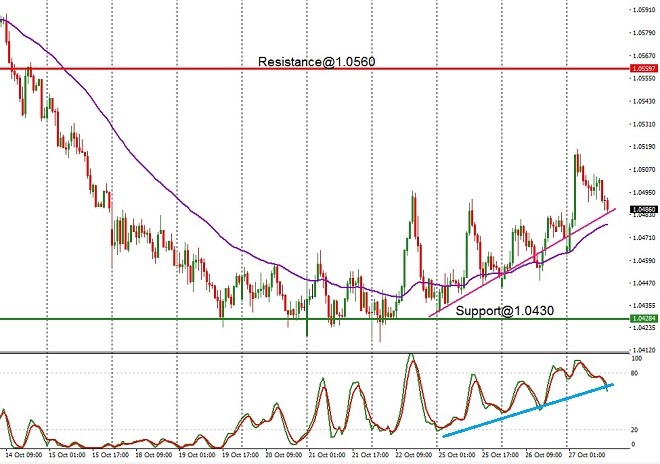
Technically, the AUD/NZD pair is rising after testing the support at 1.0430. The next resistance is anticipated only near 1.0560. Additionally, the currency pair is moving along the ascending trend line, as shown in the image below. The stochastics oscillator is also rising. Therefore, we are anticipating the currency pair to remain in an uptrend in the short term.
Disclaimer: Any financial trading analysis offered here is our opinion and is not intended as advice or direction for investors. We cannot guarantee the success of any trades made as a consequence of this article, and we encourage traders to incorporate a strong money management strategy to limit losses when they enter the markets. Please use this article as part of your own research before formulating strategies prior to trading.