
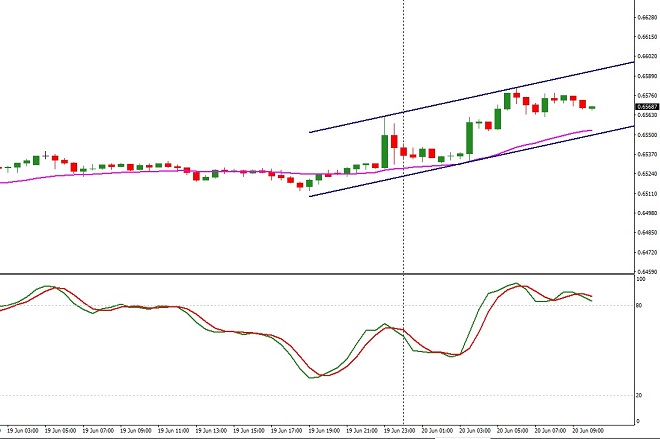
The Kiwi dollar rallied against the greenback yesterday after Statistics New Zealand reported fiscal 2019 first quarter GDP in line with analysts’ estimates. Most of the economic growth has come from the impressive performance of the construction sector. The NZD/USD pair has appreciated from a low of 0.6532 to a high of 0.6580 in the past few hours. Many economists, however, believe that the leading indicators signal an overall slowdown of the economy.
According to Statistics New Zealand, the country’s GDP increased by 0.6% q-o-q in the first quarter of 2019, in line with analysts’ estimates and unchanged from the prior quarter. On an annualized basis, GDP grew 2.5%, surpassing economists’ forecasts of a 2.3% increase. In the previous quarter, the GDP of New Zealand rose 2.3% on a y-o-y basis.
Goods-manufacturing industries grew 2% in the quarter ended in March. The growth was mainly led by improved activity in the construction sector, which grew at 3.7%, the most since 3Q17. Accordingly, investment in non-residential and residential buildings increased 9.9% and 2.7%, respectively.
Manufacturing activity grew 1.4% in the first quarter of 2019, after a 0.4% decrease in the fourth quarter of 2018. A rise in food, tobacco, and beverage manufacturing contributed immensely to the overall manufacturing growth. Other sectors that registered growth are metal product manufacturing, non-metallic mineral manufacturing, rubber product manufacturing, and petroleum, chemical, and polymer production.
However, in the first quarter of 2019, service industries recorded only a growth of 0.2%, the slowest growth rate since the third quarter of September 2012. Seven of the 11 service industries posted growth.
Commenting on the poor performance of the service sector, Kiwibank senior economist Jeremy Couchman said: “A slowing service sector is concerning. Service sector growth tends to be a stable source of growth.”
The key growth drivers were health care and social assistance (1.7%) and transport, postal, and warehousing (1.2%). Retail, accommodation, and restaurants posted a decline of 0.5%. Accommodation and restaurants recorded a decline in business activities due to a drop in tourist arrivals to New Zealand in February and March.
Household spending rose 0.5% in the first quarter, after a 1% increase in the earlier quarter. Growth was depressed in the first quarter, mainly due to a decline in spending on services (0.3%). The service expenditure grew at the slowest pace since December 2014. Spending on non-durable and durable goods rose 0.4% and 1.4%, respectively. Fixed asset investments grew 2.4% in March 2019 quarter. Likewise, business investment grew 1.9%.
Despite the reasonable growth analysts caution that the economy is slowing down. To justify their argument, analysts point to the sharp decline in the BNZ (Business NZ) Manufacturing Index (PMI) for May which stood at 50.2, far below analysts’ forecasts for a reading of 53.0. A reading below 50 indicates contraction which implies the Kiwi economy is on the verge of contraction.
Commenting on the BNZ Manufacturing Index, Business NZ’s executive director for manufacturing, Catherine Beard said: “Production (46.4) was at its lowest value since April 2012, while the other key sub-index of new orders (50.4) only just managed to stay in positive territory. Given the latter feeds through into the former, it does not instill a strong belief that the sector will show solid improvement over the next few months.”
Regarding the domestic economic scenario, Danielle Been, a foreign exchange strategist with ANZ, said: “The NZD’s resilience is starting to crack. While a more balanced RBNZ could provide some interim support, like the AUD, there is the little domestic story to justify the strength. With a challenging global story over the medium term, we think conditions are in place for the NZD to fall below fair value in 2019.”
Analysts also believe that the global economic slowdown will encourage the Reserve Bank of New Zealand to announce a rate cut.
ASB Chief Economist Nick Tuffley said, “subdued business confidence and the continued deterioration in global economic conditions may still sway the RBNZ to cut the OCR at least once more.”
The GDP data is expected to provide short-term relief for the Kiwi dollar.
Technically, the NZD/USD pair is moving within an ascending channel. The stochastic oscillator is in the bullish region. As a result, we can expect the uptrend to continue in the short-term.
Disclaimer: Any financial trading analysis offered here is our opinion and is not intended as advice or direction for investors. We cannot guarantee the success of any trades made as a consequence of this article, and we encourage traders to incorporate a strong money management strategy to limit losses when they enter the markets. Please use this article as part of your own research before formulating strategies prior to trading.