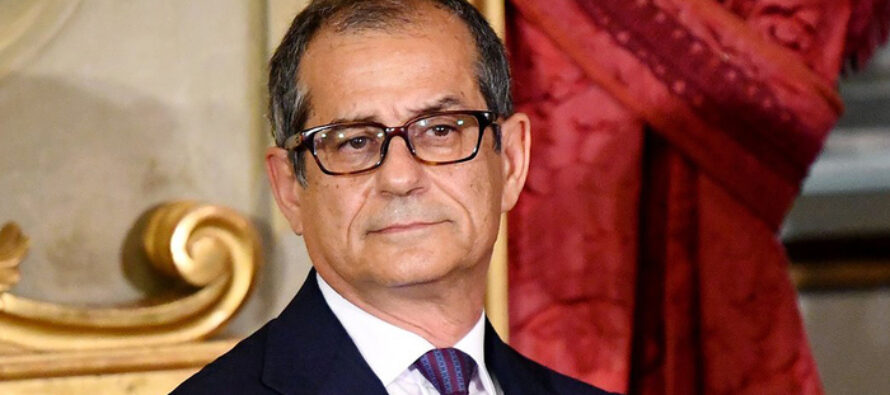
The euro-dollar fell against the greenback and other G10 currencies after Italian Finance Minister, Giovanni Tria, increased the country’s deficit to 2.4% of GDP, greater than the expectation of the European Union. The greenback, in the meanwhile, strengthened after the Federal Reserve hiked the benchmark interest rates by 25 basis points to a range of 2% to 2.25%. Surprisingly, the greenback was trading weak when the interest hike was announced.
Italy’s budget and its impact on the euro
Investors, economists, and the EU leaders, who were anticipating the newly elected government in Italy to effortlessly pass the 2019 budget, faced a rude awakening when the leaders of Italy’s ruling coalition had a standoff with the free-thinking economy minister.
For the past few weeks, investors had been comforted by news reports that Italy’s coalition government would settle for a 2019 deficit target of 2% of GDP or even lower. Economy Minister Giovanni Tria, who isn’t associated with either of the ruling coalition parties, had been suggesting a 1.6% target, much better than the 3% ceiling suggested by the EU rules.
Ultimately, the Finance Minister succumbed to the demands of the ruling coalition leaders and agreed to a deficit projection of 2.4% of GDP for 2019, in addition to campaign promises related to pensions and tax cuts. The domestic news outlet La Stampa had even reported that Tria threatened to step down, but was denied by the Economic ministry.
Commenting on the Finance Minister’s announcement, 5-Star leader Luigi Di Maio and League chief Matteo Salvini said: “There is an accord within the whole government for 2.4 percent, we are satisfied, this is a budget for change.”
Commenting on the 2.4% deficit projected by the Finance Minister, Federico Santi, an analyst at Eurasia Group said, “the latest forecast could further increase the total amount of public debt next year rather than decline.”
Federico Santi further opined that the finance minister’s decision would put Italy on a “clear collision course” with the EU which would probably reflect when the country submits its budget draft proposal to the EU in October. Additionally, it could also result in one or more credit downgrades, leading to pressure on Italian assets.
The deficit forecast news triggered an Italian bonds sell-off, with yields on 10-year bond (TMBMKIT-10yr) rising six basis points to 2.888%, after hitting a high of 2.991%, according to FactSet.
Commenting on the fiscal deficit outlook, Francesco Galietti, head of Rome-based political risk consultancy Policy Sonar, said: “Until today markets had been betting on Tria’s capacity to rein in political forces. That assumption is now crumbling.”
Echoing Galietti’s view, Armando Marozzi said “From now on things will be tough for Italy. The European Commission will reject this budget and next month rating agencies are likely to downgrade Italian bonds.”
While the euro is weakening, the greenback started strengthening due to lower-than-anticipated jobless claims and a steep rise in durable goods orders.
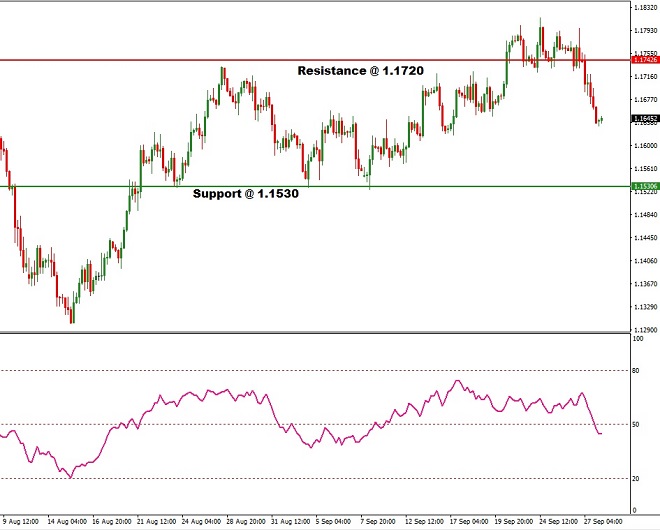
Technically, the EURUSD pair has broken the support at 1.1720. The next major support exists only at about 1.1530 levels. The money flow index has crossed below the reading of 50. As a result, we can expect the currency pair to move down further.
Disclaimer: Any financial trading analysis offered here is our opinion and is not intended as advice or direction for investors. We cannot guarantee the success of any trades made as a consequence of this article, and we encourage traders to incorporate a strong money management strategy to limit losses when they enter the markets. Please use this article as part of your own research before formulating strategies prior to trading.