
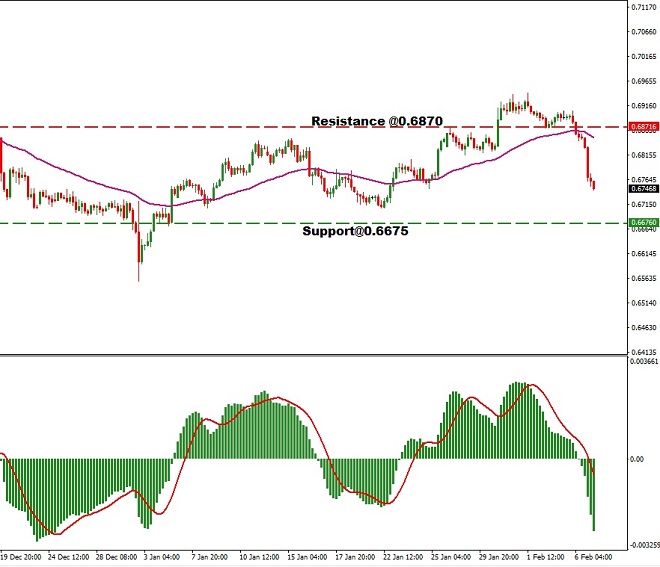
The New Zealand dollar showed strength against the US dollar yesterday morning after the Global Dairy Trade Price Index increased by 6.7% in the dairy auction. However, the antipodean currency plunged later in the day when Statistics New Zealand reported an unimpressive employment report. The slowdown in China, which is the second-largest trading partner of New Zealand, is also keeping investors and traders away from the commodity currency. Following the employment report, the NZD/USD fell to a low of 0.6750, from a high of 0.6910.
An unexpected rise in unemployment turns the kiwi dollar weak
For the fifth diary auction in a row, the Global Dairy Trade Price Index showed a rise, defying global slowdown concerns. In Wednesday’s auction, the average price of dairy products increased to $3,265 a ton, from $3,057 a ton three weeks ago. However, only 23,326 tons of dairy products were sold, down from 27,909 tons three weeks ago. The whole milk powder index rose 8.4% to $3027/metric ton, the highest level since May 2017.
Dairy prices usually have a considerable impact on the New Zealand dollar as dairy products generate the maximum export revenue for the country. Therefore, a 6.7% increase in GDT Index created a spike in the Kiwi dollar. However, the optimism faded quickly due to the release of weak employment data.
Statistics New Zealand announced that employment rose 0.1% m-o-m in the final quarter of 2018, missing economists forecast of a 0.3% increase. Most importantly, the unemployment rate increased to 4.3% in the December quarter, from 4.0% in the earlier quarter. Economists had anticipated the unemployment rate to rise slightly, but not to the extent the labor force survey revealed.
A sharp rise in the number of unemployed men contributed to the unexpected surge in unemployment. The number of men unemployed increased by 8000 to 65,000. Likewise, the number of women unemployed rose by 2000 to 55,000. Notably, for the first time in nine years, the percentage of unemployed men (4.4%) increased more than unemployed women (4.2%). Additionally, the labor cost index rose 0.5%, missing analysts’ expectation for a 0.6% increase.
ANZ senior economist Liz Kendall said, “It looks like the best that the labor market has to offer is behind us.”
The unemployment report triggered a New Zealand dollar sell-off. The decline was also fueled by a research report by Infometrics forecasting a slowdown in New Zealand’s economic growth in the years to come.
Data research firm Infometrics anticipates New Zealand’s growth to be around 3.0% in 2019. However, the firm expects the growth to dip below 2.0% by mid-2021 due to a decline in export volumes and earnings.
Commenting on the forecast Infometrics Chief Forecaster Gareth Kiernan said: “Slowing GDP growth in China and the US is weighing on New Zealand’s economic prospects. This pressure from offshore coincides with a slowdown in many of the drivers that have buoyed domestic growth over recent years.”
BNZ economist Doug Steel does not anticipate any notable increase in the prices of products exported by New Zealand in 2019. The slowdown in China is one of the major reasons for the subdued forecast. In the case of agricultural and forestry products, China represented about 28% of New Zealand exports. China also takes in nearly 24% of New Zealand’s beef exports and 30% of mutton exports. A decade before, those shares were merely 3.2% and 0.1% respectively. The facts presented here indicate that the NZD/USD will remain bearish in the near-term.
The historical price chart indicates that the NZD/USD pair has broken the support at 0.6870. The currency pair is also trading below its 50-day moving average. Additionally, the MACD histogram has a negative reading. As a result, we can anticipate the NZD/USD currency pair to remain weak in the short term.
Disclaimer: Any financial trading analysis offered here is our opinion and is not intended as advice or direction for investors. We cannot guarantee the success of any trades made as a consequence of this article, and we encourage traders to incorporate a strong money management strategy to limit losses when they enter the markets. Please use this article as part of your own research before formulating strategies prior to trading.