
The pound rallied against the greenback yesterday following the release of better-than-anticipated UK flash manufacturing PMI data for July. The weak US new home sales and manufacturing PMI data fueled the US dollar sell-off. Overall, the GBP/USD pair rose from a low of 1.2876 to a high of 1.2937 in the past 24 hours.
The S&P Global UK flash manufacturing PMI (purchasing managers’ index) increased to a 24-month high of 51.80 in July from 50.90 in the previous month, surpassing forecasts of 51.10.
Also, the UK flash manufacturing output index hit a 29-month high of 54.40 in July from 53.30 in June.
The UK flash services PMI grew to a two-month high of 52.40 in July from 52.10 in the prior month, missing forecasts of 52.50.
Overall, the UK flash PMI composite output index reached a two-month high of 52.70 in July from 52.30 earlier, hinting at a robust reversal in private sector activity. Notably, the private sector has been recording growth for each of the last nine months.
In the UK, companies primarily recorded increased output due to robust order book volumes while also focusing on reducing outstanding workloads. In July, activity growth among service firms saw a slight acceleration, bolstered by a significantly quicker rise in fresh work compared to June. However, the rate of business expansion remained one of the mildest recorded in 2024 so far.
Sales growth in both the manufacturing and services sectors accelerated in July, resulting in a robust increase in cumulative fresh business since April 2023. The latest poll information indicated a strengthening of employment increase at the beginning of the third quarter, with staffing numbers rising at a solid rate, the fastest recorded in just over a year.
After reaching a six-month nadir in June, business optimism across the UK rebounded in July, nearly matching the two-year high recorded in February.
According to the US Census Bureau, the country’s goods trade deficit narrowed to $96.80 billion in June from $99.40 billion in the previous month, bettering forecasts of $98.80 billion.
The US goods exports were valued at $172.30 billion, an increase of $4.30 billion from May. Likewise, US goods imports were valued at $269.20 billion, up $1.70 billion from May.
The preliminary data published by the US Census Bureau also indicated that US wholesale inventories grew by 0.20% m-o-m in June to $903.30 billion, after an increase of 0.6% in the previous month. Economists had anticipated the US wholesale inventories to increase by 0.50%. On a y-o-y basis, US wholesale inventories inched up 0.10% in June 2024.
In a separate news release, the US Census Bureau stated that the country’s new home sales declined 0.60% to 617,000 units in June from 621,000 units in the previous month, missing forecasts of 639,000.
On a y-o-y basis, US new home sales fell by 7.40% to 666,000 in June 2024.
The S&P Global US flash manufacturing PMI declined to a seven-month low of 49.50 in July from 51.60 in the previous month, missing forecasts of 51.70. A reading below 50 indicates contraction, and vice versa. The reported figure reflects a deterioration in the business environment within the goods manufacturing sector for the first time since December 2023.
Also, the US flash manufacturing output index hit a six-month low of 49.50 in July from 52.10 in the previous month.
The US flash services PMI surged to a 28-month high of 56 in July from 55.30 in the previous month, surpassing forecasts of 54.70.
Overall, the US flash PMI composite output index jumped to a 27-month high of 55 in July from 54.80 in June.
Output has consistently increased over the past eighteen months, with the rate of expansion accelerating significantly in recent months following a slowdown in April.
The upbeat UK economic data and the mixed US information are expected to keep the GBP/USD pair range-bound in the short term.
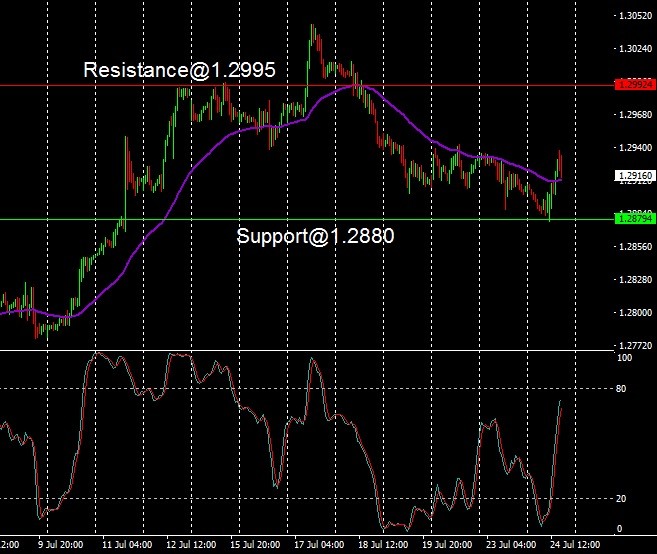
The historical price chart indicates that the GBP/USD pair is rising after testing the support at 1.2880. The next resistance is anticipated to be only near 1.2995. Additionally, the currency pair is trading above its 50-day moving average, while the stochastic indicator is rising towards the bullish zone. Therefore, we anticipate the GBP/USD pair to remain in an uptrend for the next few trading sessions.
Disclaimer: Any financial trading analysis offered here is our opinion and is not intended as advice or direction for investors. We cannot guarantee the success of any trades made as a consequence of this article, and we encourage traders to incorporate a strong money management strategy to limit losses when they enter the markets. Please use this article as part of your own research before formulating strategies prior to trading.