The Australian dollar fell in the morning yesterday after the Reserve Bank of Australia reported a 0.6% q-o-q rise in the consumer price index, missing forecasts for a 0.7% rise. In particular, the Aussie fell to a low of 87.64 against the yen. The Japanese Ministry of Economy, Trade, and Industry reported that the preliminary industrial production grew 2.7% m-o-m in December.
Those figures aided the decline in the AUDJPY pair in the morning session. However, by the end of the day, the Australian dollar recovered its losses due to poor Japanese housing data. We expect the AUDJPY pair, which is trading at about 87.90, to gain further in the days ahead.
The price of iron ore fell to about $73 per ton CFR China. Since January 11, the price of iron ore had fallen by about 7.7%. However, it should be remembered that the average traded price of iron ore in 2017 is only $71 per ton. Therefore, Australian miners still realize a better value for the commodity. The Australian government has forecasted a price of only $51.50 per ton for iron ore in 2018. So, the Australian dollar will only be strengthened by the current price.
According to an Australian Industry Group survey released last week, investment plans and employment growth expectations remain the strongest since 2012. The Australian CEOs are also extremely optimistic about the year ahead. According to AI Group chief Innes Willox, nearly 67.3% of businesses expect an increase in sales, turnover, and margins. The Australian economy is also expected to add at least 403,000 jobs in the current year.
In Japan, the Ministry of Land, Infrastructure, Transport, and Tourism reported a 2.1% y-o-y decline in housing starts in December, versus a 1.1% increase expected by analysts. In the previous month, the housing starts declined 0.4%. Following the conclusion of a two-day monetary policy meeting last week, the Bank of Japan left the monetary policy unchanged.
Furthermore, the BoJ Governor Haruhiko Kuroda said that the economic situation is not conducive for the central bank to consider tightening its ultra-loose fiscal policy. Therefore, the market expects the short-term interest rate to remain at a negative 0.1% in the foreseeable future. So, the poor housing data and interest rate differentials favor an uptrend in the AUDJPY pair.
Technically, the price chart indicates the formation of an ascending triangle. The positive reading of the MACD histogram indicates bullishness in the AUDJPY pair. Therefore, we are expecting a breakout to happen soon.
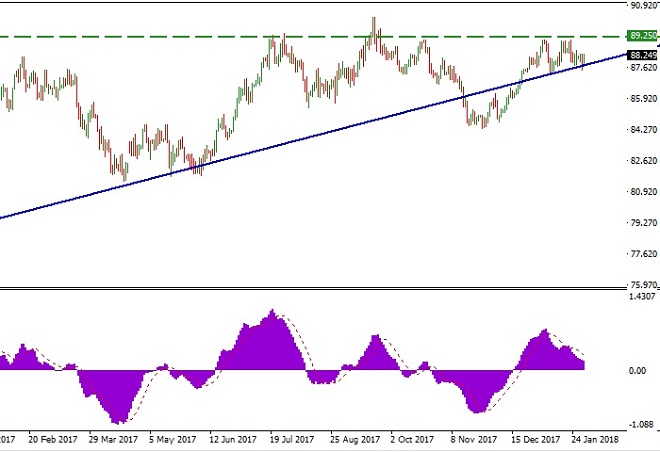
To trade the impending rally, we may open a long position in the AUDJPY pair near 88.0. A stop-loss order will be placed below 87.0 to minimize risk. We would liquidate our long position when the pair reaches the level of 90.10.
Simultaneously, based on the analysis, we may also acquire a call option from a reputed binary broker. The option should remain active for a period of one week. In order to invest in the option contract, the AUDJPY pair should also be trading near 88.0 in the spot Forex market.
Disclaimer: Any financial trading analysis offered here is our opinion and is not intended as advice or direction for investors. We cannot guarantee the success of any trades made as a consequence of this article, and we encourage traders to incorporate a strong money management strategy to limit losses when they enter the markets. Please use this article as part of your own research before formulating strategies prior to trading.