The Eurodollar declined against the greenback yesterday despite the release of better than anticipated German Ifo business climate and Belgium Business Confidence index data for April. There were no other major economic releases yesterday. The market is anticipating a 50-basis points rate hike in the US Fed policy meeting scheduled for May 4. This keeps the greenback slightly bullish against its rivals, including the euro. Overall, on the first trading day of the week, the EUR/USD pair declined from a high of 1.0820 to a low of 1.0765.
The German Ifo Institute has stated that the business climate index has increased to 91.80 in April, from a 14-month low of 90.80 in March, and surpassed economists’ forecasts of 89.10 as firms were less pessimistic after the initial jolt created by the Ukraine-Russia war.
The current conditions index inched higher to 97.20 in April, from 97.10 in the prior month. The expectations index rose to 86.70 in April from 84.90 in March. Supply chain delays stood as a key issue for the industry, with 75% of enterprises pointing to difficulties and three out of four retailers intending to upwardly revise prices. Germany’s economy seems robust after the initial jolt, as per Ifo economists.
According to the data published by the National Bank of Belgium, the country’s Business Confidence Index rose to 2.40 in April, from 0.40 in March, and delighted economists who were anticipating a decline in the Business Confidence to 0.20 points.
Notably, devoid of business-related services, the business environment in all segments of surveyed economic activity recorded an increase.
Specifically, business confidence in the manufacturing industry increased to 0.50 in April, from -2.70 in the prior month. Business-related services recorded a decline to 11.70 points, from 15.10. The building industry posted an increase to 2.10 points, from 1.20 points. Trade reported a rise of 0.30 in April, from -6.50 in March.
Overall, the production capacity utilization rate in the manufacturing sector has increased considerably, hitting 81.80% in April, a figure considerably higher than the long-term average.
The solid economic data coupled with steep US rate hike expectations are expected to keep the EUR/USD pair range-bound with a slight bearish bias in the short term.
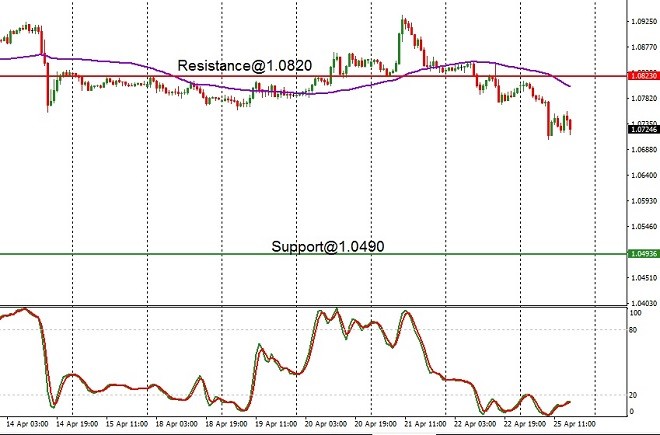
The historical price chart indicates that the EUR/USD pair is declining after facing resistance at 1.0820. The next support is anticipated only near 1.0490. Additionally, the currency pair is trading below its 50-day moving average, while the stochastics indicator is in the bearish zone. Therefore, we are anticipating the currency pair to remain in a downtrend in the short term.
Disclaimer: Any financial trading analysis offered here is our opinion and is not intended as advice or direction for investors. We cannot guarantee the success of any trades made as a consequence of this article, and we encourage traders to incorporate a strong money management strategy to limit losses when they enter the markets. Please use this article as part of your own research before formulating strategies prior to trading.