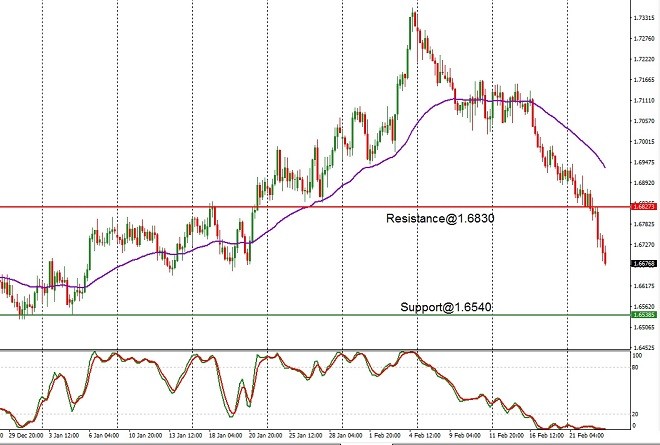
The eurodollar plunged against the New Zealand dollar yesterday following the rate hike announced by the Reserve Bank of New Zealand and the overall hawkish stance taken by the policy committee. The euro’s decline was also stoked by the unexpectedly steep decline in the German consumer sentiment. Overall, the EUR/NZD pair declined from a high of 1.6830 to a low of 1.6670.
According to the German GfK institute, the consumer sentiment index has dropped to -8.10 in March, from -6.70 in February, and disappointed economists who were anticipating a slight improvement in the consumer sentiment index to -6.30.
The economic expectations index, however, rose for the second consecutive month. Following an increase of 1.30 points on a m-o-m basis, the index has reached 24.10 in March. The reading reflects an increase of nearly 16 points compared with March 2021.
The income expectations index resumed its downtrend with a 13 point loss to 3.90 points in March, reflecting the lowest level in a year. In January, the income expectations index stood at -2.90.
Furthermore, the inclination to purchase has also decreased by 3.80 points to 1.40 in March, reflecting a 6 point fall from March 2021.
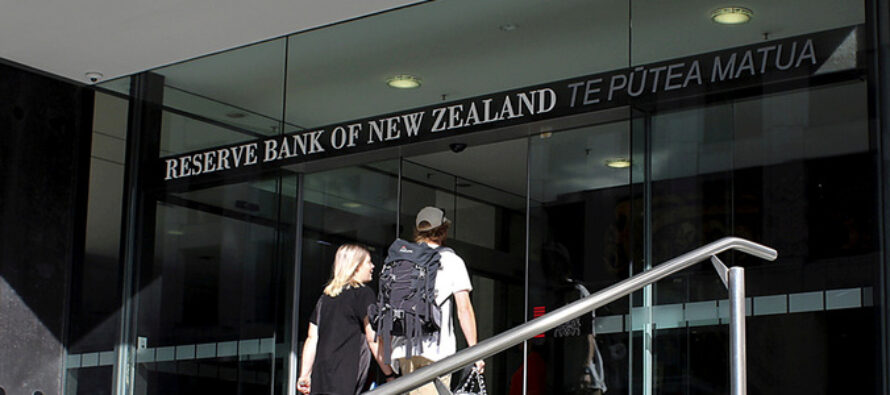
Earlier in the Asian session, the Reserve Bank of New Zealand announced a 25 basis point rate hike that took the benchmark interest rate (or Official Cash Rate) to 1%. The third successive rate hike was in line with economists’ expectations. Following the rate hike, the borrowing costs reached the pre-pandemic levels.
Additionally, the central bank also hinted at a more vigorous policy tightening course to combat inflation, which currently stands at 5.90%. The prevailing inflation is nearly double the RBNZ’s target range of 1% to 3%. Interestingly, the country’s employment rate has hit a historical low of 3.20%. However, housing prices have skyrocketed to record highs.
The central bank has also disclosed plans to end its N$50 billion (~$33.82 billion) bond holdings amassed as part of the Large Scale Asset Purchase (LSAP) program. A combo of guided sales and maturity (bonds) will be used for the tapering process.
Notably, RBNZ has categorically stated that it will not reinvest the funds generated from the matured bonds, and holdings will be slashed at a rate of $5 billion per year.
Also, the central bank upwardly revised its benchmark rate to 3.35% at the end of 2024, far greater than the 2.60% projected last November. With this rate hike, the markets anticipate OCR to hit 2.50% by the end of 2022, an increase from the earlier level of 2.25%.
The governor of RBNZ, Adrian Orr, stated that the central bank was almost on the verge of delivering a 50-basis point rate hike and such a scenario is possible, if the situation warrants, in the future. The hawkish statement strengthened the Kiwi dollar at a rapid pace against its peers, including the euro.
The hawkish stance taken by the Reserve Bank of New Zealand is expected to keep the Kiwi dollar bullish against its peers, including the euro, in the short term.
Technically, the EUR/NZD pair is declining after breaking the support at 1.6830. The next support is anticipated only near 1.6540. Additionally, the currency pair is trading below its 50-day moving average, while the stochastics indicator is in the bearish zone. Therefore, we are anticipating the EUR/NZD pair to remain in a downtrend in the near term.
Disclaimer: Any financial trading analysis offered here is our opinion and is not intended as advice or direction for investors. We cannot guarantee the success of any trades made as a consequence of this article, and we encourage traders to incorporate a strong money management strategy to limit losses when they enter the markets. Please use this article as part of your own research before formulating strategies prior to trading.