The Aussie gained ground against the greenback yesterday following the release of better-than-anticipated retail sales and building approvals data for May. The AUD/USD pair’s uptrend was also fueled by lower-than-anticipated non-farm payroll data for June. Also, the US trade deficit data for May also missed estimates. Overall, the AUD/USD pair rallied from a low of 0.6665 to a high of 0.6700 in the past 24 hours.
According to the Australian Bureau of Statistics (ABS), the country’s retail sales inched up 0.60% m-o-m in May following a 0.10% increase in the previous month, surpassing forecasts of 0.30% growth.
The increase was led by food retailing, which grew by 0.70% m-o-m (or A$102.30 million) in May. Specifically, liquor retailing jumped 6.10% (or A$87.40 million) in May. Supermarkets and grocery stores inched up 0.10% in the same period. Other specialized food retailing grew by 0.30% (or A$2.80 million).
Household goods retailing rose 1.10% (or A$62.20 million) in May. In particular, furniture, floor coverings, houseware, and textile goods retailing surged 3.10% (or A$46.80 million). In May, electrical and electronic goods retailing inched up 0.80% (or A$15.50 million).
In May, clothing, footwear, and personal accessory retailing increased by 1.6% (or A$48.10 million). Exactly, clothing retail sales rose by 1.60% m-o-m (or A$31.80 million) in the same period. Footwear and other personal accessory retailing grew by 1.70% (A$16.30 million).
Department store sales inched down 0.90% (or A$16.40 million) in May. Also, the cumulative online retail sales were A$4.16 billion in May. Overall, on an m-o-m basis, the percentage of online sales to aggregate retailing jumped to 11.40% in May from 11% in April.
On a y-o-y basis, Australia’s retail sales surged 1.70% in May 2024.
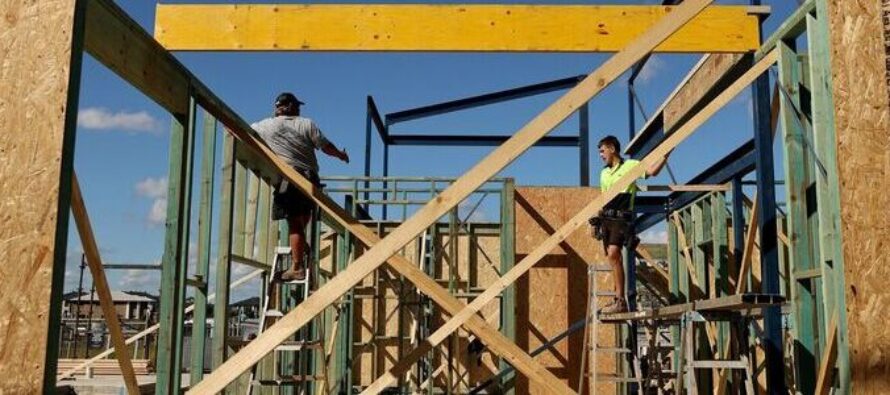
In a separate news release, the ABS stated that building approvals rose by 5.50% m-o-m in May to 14,175 units, following a 1.90% rise in the previous month, blowing away forecasts of 1.50% growth.
Private sector house approvals rebounded with a growth of 2.10% m-o-m in May to 9,163 after declining by 0.30% in April. Likewise, private sector dwellings, excluding houses, surged 16.30% m-o-m to 4,858 units after recording a 3.10% rise in the previous month.
The value of total residential buildings increased by 2.30% m-o-m in May to A$7.64 billion. The value of non-residential buildings declined by 1.60% in May to A$5.41 billion. Overall, the value of total buildings approved grew by 0.60% m-o-m in May to A$13 billion.
The US ADP non-farm (private sector) payrolls increased by 150,000 in June following an addition of 157,000 jobs in the previous month but missed forecasts of 163,000.
The goods-producing industries added 14,000 jobs. Specifically, the construction sector added 27,000 jobs. However, the manufacturing and natural resources/mining sectors lost 5,000 and 8,000 jobs, respectively.
The service-providing industries added 136,000 jobs. In particular, the trade, transportation, and utilities sectors added 15,000 jobs. The professional/business services sector added 25,000 jobs. Notably, the leisure/hospitality sector recorded an addition of 63,000 jobs. Also, the education and health services sector added 9,000 jobs.
As per the US Department of Labor, the country’s first-time jobless claims rose to 238,000 in the week that ended on June 29 from 234,000 (upwardly revised from 233,000). Economists had anticipated unemployment claims of 234,000.
The four-week moving average was 238,500, an increase from 236,250 (upwardly amended from 236,000) in the previous week.
According to the Bureau of Economic Analysis, the US trade deficit widened to $75.10 billion in May from $74.50 billion in the previous month, bettering forecasts of $76.30 billion.
US exports were $261.70 billion in May, down $1.80 billion from April. Likewise, US imports were $336.70 billion in May, a decrease of $1.20 billion from April.
The widening of the trade deficit was an outcome of a $0.90 billion increase in the goods deficit to $100.20 billion. However, this was partly negated by a rise in the service surplus of $0.30 billion to $25.10 billion.
Exports of goods fell by $2.90 billion to $169.60 billion in May. Simultaneously, exports of services rose by $1.10 billion to $92.10 billion in the same period. Imports of goods declined by $2 billion to $269.70 billion in May. In the same period, imports of services grew by $0.90 billion to $67 billion.
The better-than-anticipated Australian economic data is expected to keep the AUD/USD pair slightly bullish in the short term.
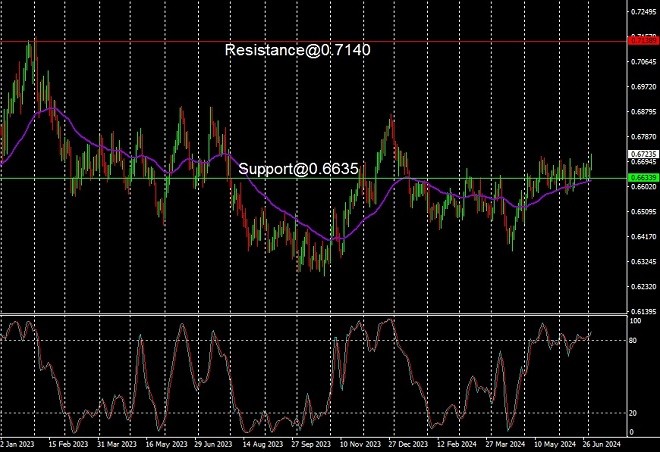
Technically, the AUD/USD pair is rising after testing the support at 0.6635. The next resistance is anticipated to be only near 0.7140. Additionally, the currency pair is trading above its 50-day moving average, while the stochastic indicator is in the bullish zone. Therefore, we anticipate the AUD/USD pair to remain in an uptrend for the next few trading sessions.
Disclaimer: Any financial trading analysis offered here is our opinion and is not intended as advice or direction for investors. We cannot guarantee the success of any trades made as a consequence of this article, and we encourage traders to incorporate a strong money management strategy to limit losses when they enter the markets. Please use this article as part of your own research before formulating strategies prior to trading.