Last Friday, during a live broadcast cabinet meeting, the US president reaffirmed that his administration is not in talks with Canada on NAFTA related issues. Trump also stated that tariffs are set too high, and there are severe trade restrictions that require addressing. More importantly, Trump suggested that the US sidelined Canada purposely due to positive developments in negotiations between the US and Mexico.
For the past month, the US trade representative Robert Lighthizer and Mexican Economy Minister Ildefonso Guajardo, have been working together to arrive at a final solution on trade-related issues. Canada was not included in the talks. Trump’s statement turned the Canadian dollar weak against the currencies of other developed countries. However, the economic data released on Friday is expected to support a reversal in the week ahead.
Consumer Price Index:
Statistics Canada stated that the annual inflation rate in July rose to its highest level since September 2011, mainly due to increased gasoline prices. The federal agency revealed that the consumer price index for July rose 3% on a y-o-y basis, compared with a 2.5% gain in June. Analysts polled by Thomson Reuters Eikon had expected an inflation rate of 2.5% on a y-o-y basis. On an m-o-m basis, consumer prices increased 0.5% in July, versus economists’ expectation of a 0.1% rise. In June, the consumer prices increased 0.1%.
The reported inflation is now at the upper end of the inflation target range of between 1% and 3% stipulated by the Bank of Canada. Notably, the Bank of Canada had predicted the inflation to reach a level of up to 2.5%, mainly due to temporary factors such as high energy prices. The central bank expects inflation to dip to 2% late next year.
Excluding volatile food and energy prices, the average of three measures of core inflation increased to 2%, from 1.96% in June. Economists anticipate the next rate hike in October as the underlying inflation continues to remain on target.
International investments
Overseas investments in Canadian securities increased to $11.50 billion in June, from a mere $3 billion in May. Likewise, Canadian investment in securities abroad increased to $11.30 billion, the highest level since January 2018. Overall, Canada received a net inflow of $256 million in June, reaching a level of $7.6 billion in 2Q18.
Impact on EURCAD pair
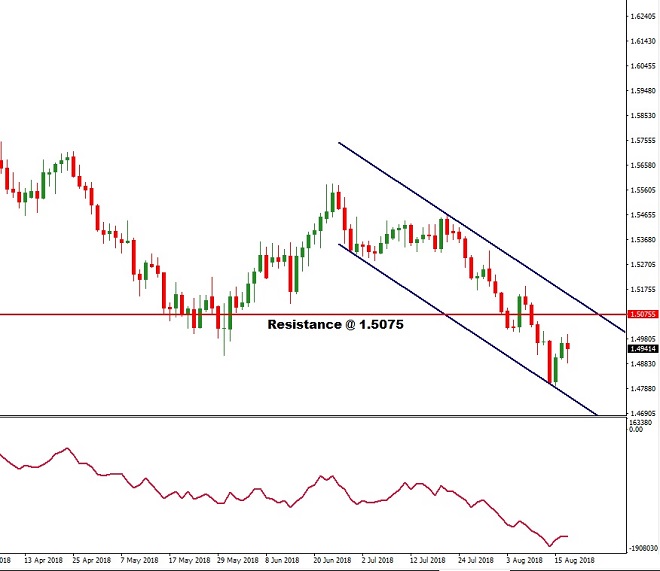
The eurodollar remains weak on Turkish contagion fears. So, positive economic data only avoids the euro from sliding further. This is expected to give an upper hand to the Canadian dollar in the coming week. The EURCAD pair remains on a downtrend as shown in the image below. Furthermore, the accumulation/distribution indicator is also making new lows. Therefore, a continuation of the downtrend can be expected in the EURCAD pair.
Disclaimer: Any financial trading analysis offered here is our opinion and is not intended as advice or direction for investors. We cannot guarantee the success of any trades made as a consequence of this article, and we encourage traders to incorporate a strong money management strategy to limit losses when they enter the markets. Please use this article as part of your own research before formulating strategies prior to trading.