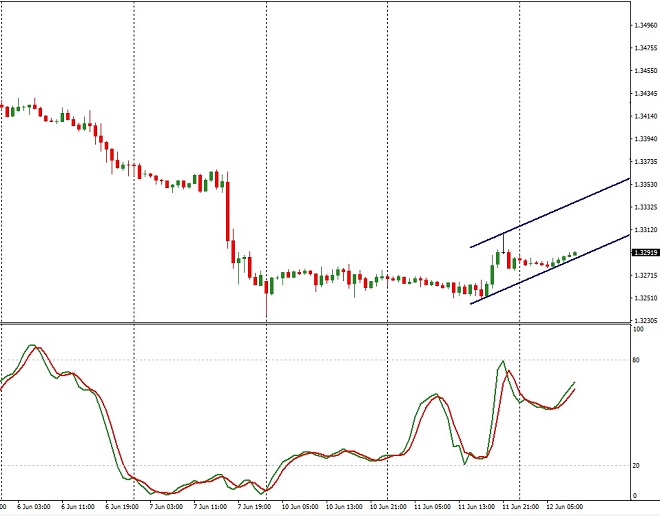
The Canadian dollar started weakening Tuesday following the release of mixed economic data. The loonie failed to maintain the momentum from the previous week’s upbeat economic data, slowly losing gains made against the greenback. The Canadian dollar may remain bearish during the summer as the central bank may hold back its fierce normalization plan until the completion of the federal election. In the past 24 hours, from a low of 1.3250, the USD/CAD pair rose to 1.3310, before settling down at 1.3290.
The Canada Mortgage and Housing Corporation (CMHC) revealed that the seasonally adjusted housing starts declined to 202,337 units in May, down from the earlier month’s 233,410. Toronto and Vancouver, two of Canada’s biggest housing markets recorded the maximum housing starts at 42,667 and 19,943, respectively, in May. On the contrary, Ottawa and Calgary recorded housing starts of only 9,545 and 7,624, respectively, during the same period.
Notably, Statistics Canada reported a 14.7% increase in building permits in April, an increase from 2.8% in March. The market had forecast a rise of only 3.5%. The real estate sector is anticipated to record a 0.1% decline in housing prices in April. Data pertaining to housing prices will be reported later today.
Employment data published last week indicated that the Canadian economy added 27,000 jobs in May, far below the 106,500 jobs added in the earlier month. Economists had anticipated the economy to add merely 8,000 jobs. The unemployment rate also fell to 5.4%, from 5.7% earlier,
In particular, the labor report indicated that jobs declined in business services, public administration, and food and accommodation services. The most significant increase in jobs happened in Nova Scotia (21,000), Ontario (21,000), New Brunswick (400), and British Columbia (4,500). The biggest declines were recorded in Prince Edward Island (700) and Newfoundland and Labrador (2,700).
Economists pointed out that the record low employment rate backs the Bank of Canada’s (BOC)’s outlook that the economy will bounce back following a short-term softening. As of now, the Bank of Canada is not anticipated to modify interest rates, at least until after the election. In fact, many economists believe that the interest rates would be slashed by 25 basis points in the second quarter of 2020.
A fall in crude oil prices also aided the greenback’s rally. US West Texas Intermediate (WTI) crude futures declined $0.85, or 1.6%, to $52.41 per barrel. Volatility in energy prices would severely affect the domestic economy as crude oil is Canada’s top export commodity.
The weak housing permits data, fall in crude prices, and postponement of policy normalization has turned the Canadian dollar weak.
The historical price chart indicates that the USD/CAD pair has started moving upwards after testing support at 1.3250 levels. The stochastic indicator is rising, while the currency pair is moving within the ascending trend line. As a result, we can expect the currency pair to move up in the short-term.
Disclaimer: Any financial trading analysis offered here is our opinion and is not intended as advice or direction for investors. We cannot guarantee the success of any trades made as a consequence of this article, and we encourage traders to incorporate a strong money management strategy to limit losses when they enter the markets. Please use this article as part of your own research before formulating strategies prior to trading.