
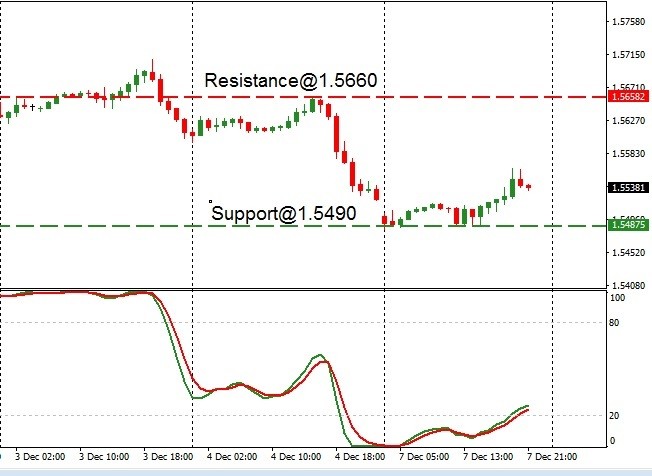
The eurodollar gained against the Canadian dollar following the report of overwhelmingly optimistic German industrial production data and a sharp improvement in investor confidence. The Ivey PMI (Purchasing Managers’ Index) from Canada was better than anticipated by economists but slightly lower on a m-o-m basis. That enabled the eurodollar to gain ground against the Canadian dollar. In the last 24 hours, the EUR/CAD pair has rallied from a low of 1.5490 to a high of 1.5560.
According to Destatis, German industrial production increased 3.2% m-o-m in October, following an increase of 2.3% in the earlier month and greater than the 1.8% growth anticipated by economists. The reported figure represents the sixth consecutive month of increase. On a y-o-y basis, industrial production expanded 3% in October 2019.
Compared with pre-pandemic February, on a seasonally adjusted basis, production in October was 4.9% lower. Production in the auto sector, the biggest division of the manufacturing industry, expanded 9.9% m-o-m in October. Still, it remained 6% below the pre-pandemic February level.
Energy production, barring construction, expanded 3.3% m-o-m in October. Within the industrial sector, the production of intermediate products recorded a growth of 4%, while capital goods production increased by 5.2%. Production of consumer goods fell by 2.4%. Outside the industrial sector, during October, the energy and construction sector recorded growth of 4% and 1.6%, respectively.
According to Sentix, the Eurozone investor confidence index improved to negative 2.7% in December, from -10 in the earlier month and far better than the reading of -11.90 anticipated by the market. The index has recorded a sharp rise not only in Europe but also in Japan and the US. Even the current situation index has been improving but at a slower rate.
The sharp rise is based on the expectation that the COVID-19 pandemic can be contained using vaccines, which are on the verge of being rolled out. This is spurring overall growth. The Sentix Global Aggregate Overall Index has risen by 6.10 points, the highest reading since May 2019.
According to data published by Richard Ivey School of Business, Ivey PMI (purchasing managers index), which measures month-over-month changes in economic activity, declined to 52.70 in November, from 54.50 in the earlier month and greater than the reading of 52.30 anticipated by economists. Ivey PMI reading eases the process of forecasting Canadian microeconomic activity.
The positive economic data from both the Eurozone and Canada is expected to keep the EUR/CAD pair range-bound with a slight bullish bias.
The historical price chart indicates that the EUR/CAD pair is rising after testing support at 1.5490. The next resistance is anticipated only near 1.5660. Additionally, the stochastic oscillator is also ascending out of the oversold region. Therefore, we are anticipating the currency pair to rally in the days ahead.
Disclaimer: Any financial trading analysis offered here is our opinion and is not intended as advice or direction for investors. We cannot guarantee the success of any trades made as a consequence of this article, and we encourage traders to incorporate a strong money management strategy to limit losses when they enter the markets. Please use this article as part of your own research before formulating strategies prior to trading.