The Aussie remained range-bound against the yen yesterday following the release of weak economic data from both Australia and Japan. While Japan’s preliminary industrial production data for April missed estimates by a wide margin, the Australian current account surplus for March 2022 quarter did not meet economists’ expectations. Overall, the AUD/JPY pair remained range-bound between 91.58 and 92.50 in the past 24 hours.
According to Japan’s Statistics Bureau, the country’s unemployment rate declined to 2.50% in April, from 2.60% in March and a notch lower than the 2.60% jobless rate anticipated by economists. The reported unemployment rate reflects the lowest level since March 2020.
On a y-o-y basis, the count of jobless people fell by 10.90% (or 23,000) to 1.88 million. The number of employed people rose by 0.40% (or 24,000) to 67.27 million. Also, the labor force participation rate stood at 62.60%.
Overall, the job availability ratio increased to 1.23 in April, from 1.22 in the prior month, implying there were 123 job openings for every 100 individuals in search of jobs.
According to the preliminary data published by the Ministry of Economy, Trade and Industry (METI), the country’s industrial production fell by 1.30% m-o-m in April, following a 0.30% growth in the prior month and worse than the 0.10% contraction anticipated by economists.
Correspondingly, the seasonally adjusted production index fell to 95.20 in April.
On a y-o-basis, Japan’s industrial production fell by 4.80% in April 2022.
Shipments remained unaltered from last month, with the corresponding index at 93.30 in April. Compared with the similar period last year, the shipments index fell by 4.30% in April 2022.
Inventories declined 2.50% m-o-m in April. Correspondingly, the inventories index was 98.40. Notably, inventories surged 3.90% from the comparable period last year.
The inventory ratio fell by 3.20% m-o-m in April, and the inventories index was 115.60. However, the inventory ratio jumped 8% on a year-on-year basis.
Japan’s METI also stated that the country’s retail sales increased 2.90% y-o-y in April, following a 0.70% growth in the prior month and surpassed the 2.60% growth anticipated by economists. The reported reading reflects the second consecutive monthly growth in retail trade and the steepest rate of increase since May last year. The increase was led by robust consumption as COVID-19 remained under control.
General merchandise sales increased 8% in April, following a 1.90% rise in March.
Food & beverages posted a four-month high growth of 0.40% in April, compared with flat reading in the earlier month. Fabric apparel & accessories rebounded with a sales increase of 9.50% rise in April, following a 7.20% drop in March. Machinery and equipment recorded an increase of 1.60%. Also, fuel sales surged 13.90%, while medicine & toiletries posted an increase of 1.90%. However, motor vehicle sales declined by 8.50%, reflecting the eighth successive month of decrease.
On a m-o-m basis, retail sales increased 0.80% in April, mirroring the second successive month of growth.
As per the data published by the Australian Bureau of Statistics (ABS), the country’s building approvals unexpectedly fell by 2.40% m-o-m in April, following a decline of 19.20% in the prior month, and disappointed economists who were anticipating growth of 2.20%.
On a y-o-y basis, Australia’s building approvals plunged 32.40% in April 2022.
Private sector house approvals increased 0.50% m-o-m to 10,077 units in April. Excluding houses, private sector dwellings fell by 6.10% in April, following a 30.60% drop in March. The value of non-residential building approvals also declined 30% in April, following a rise of 2.70% in March.
The value of total building approvals declined 12% in April. In particular, the value of total residential buildings rose by 4.70% in April, following an 18.70% drop in March.
The ABS has stated that Australia’s current account surplus fell to A$7.53 billion in March 2022 quarter, from A$13.20 billion in December 2021 quarter, and disappointed economists who were anticipating an increase in the current account surplus to A$13.40 billion.
The capital and financial account deficit declined A$8.406 billion to A$2.921 billion.
The goods and services surplus was A$560 million in 1Q22, down A$8.917 billion from a surplus of A$9.477 billion in the December 2021 quarter. The sharp decline is expected to shave off 1.70% from the GDP figure for the March 2022 quarter.
Goods exports increased 9.30% (or A$11.384 billion (to A$133.523 billion, with volumes declining 1.30% and prices rising by 10.80%. Goods imports increased 12.30% (or A$11.22 billion) to A$102.65 billion, with volumes rising by 8.30% and prices increasing by 3.70%.
At the end of March 2022, the country’s net international investment liability position was A$821.322 billion.
The weak economic data from both Japan and Australia is expected to keep the AUD/JPY pair range-bound in the short term.
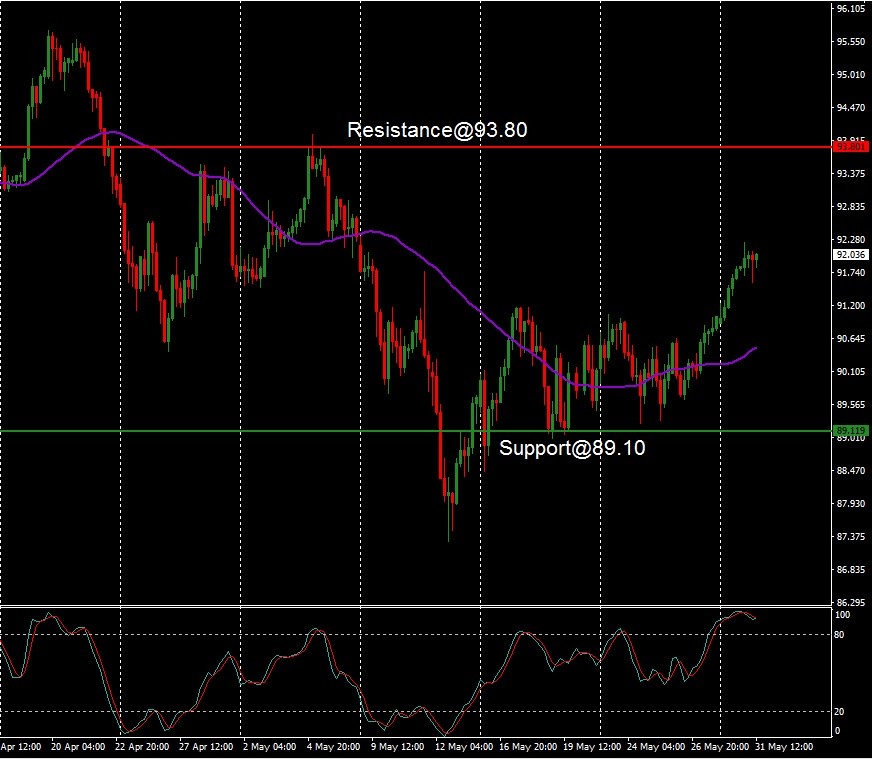
Technically, the AUD/JPY pair is rising after testing the support at 89.10. The next resistance is anticipated only near 93.80. Additionally, the currency pair is trading above its 50-day moving average, while the stochastics indicator is in the bullish zone. Therefore, we are anticipating the currency pair to remain in an uptrend in the short term.
Disclaimer: Any financial trading analysis offered here is our opinion and is not intended as advice or direction for investors. We cannot guarantee the success of any trades made as a consequence of this article, and we encourage traders to incorporate a strong money management strategy to limit losses when they enter the markets. Please use this article as part of your own research before formulating strategies prior to trading.