Video Source: Sky News on YouTube
The pound fell against the greenback yesterday following the release of unexpectedly weak GDP data for July. The US core inflation data for August was slightly higher than estimates, fueling bets on another rate hike by the US Fed. Overall, the GBP/USD pair declined from a high of 1.2497 to a low of 1.2434 in the past 24 hours.
According to the data published by the UK Office for National Statistics, the country’s economy contracted 0.50% m/m in July, following a GDP growth of 0.50% in the previous month. Economists did not anticipate the UK’s economy to decline more than 0.20%. Notably, all three main sectors recorded a contraction.
However, compared with the previous three months, in the three months ended July, GDP inched up 0.20%. All three key sectors posted growth. The economic contraction was mainly led by services, which posed a 0.50% decline in output in July following an increase of 0.20% in June. Consumer-facing services recorded no growth in July following a 0.50% expansion in the earlier month.
In a separate news release, the Office for National Statistics (ONS) stated that the UK’s construction output contracted 0.50% m-o-m in July, following a 1.60% increase in the previous month and line with economists’ estimates. The decline was led by a 1.30% drop in repair and maintenance. However, fresh work grew by 0.10% m-o-m in July.
Five out of nine sub-sectors posted a decline in July. Private housing repair and maintenance and private housing new work declined by 3.90% and 2.20%, respectively.
In the three months to July, construction output stood unchanged. This follows a 0.30% growth in fresh work, negated by a 0.40% decline in repair and maintenance.
The ONS revealed that the UK’s industrial production inched down by 0.70% m-o-m in July, following a 1.80% growth in the previous month and a notch lower than forecasts of a 0.60% decline.
Three out of four production sectors posted a decline. The manufacturing sector posted a 0.80% contraction. Likewise, electricity and gas reported a 1.50% decrease. Additionally, water supply and sewerage recorded a drop of 0.50%. This was partly negated by a 1.90% growth in mining and quarrying.
The UK’s manufacturing production fell by 0.80% m-o-m in July, following 2.40% growth in the previous month but slightly better than forecasts of a 0.90% decline. Nine out of 13 subsectors recorded contractions. Rubber and plastic products recorded a decrease of 5.50%. Similarly, electronic and optical products posted a decline of 3.20%.
According to the US Bureau of Labor Statistics, the country’s consumer price index inched up 0.60% m-o-m in August, following a 0.20% rise in the previous month and line with economists’ estimates. The energy index grew by 5.60% in August. Likewise, the food index rose by 0.20%. Specifically, the index for food at home grew by 0.20% m-o-m in August, while the index for food away from home inched up 0.30% in the same period.
Excluding food and energy, the core consumer price index inched up 0.30% m-o-m in August, following a 0.20% increase in the previous month. Economists had anticipated that core inflation would rise by only 0.20%.
The US consumer price index surged 3.70% y-o-y in August, following a 3.20% rise in July and a notch higher than forecasts of a 3.60% increase.
Excluding food and energy, the US consumer price index grew by 4.30% y-o-y in August. The energy index fell by 3.60% while the food index rose by 4.30% in the same period.
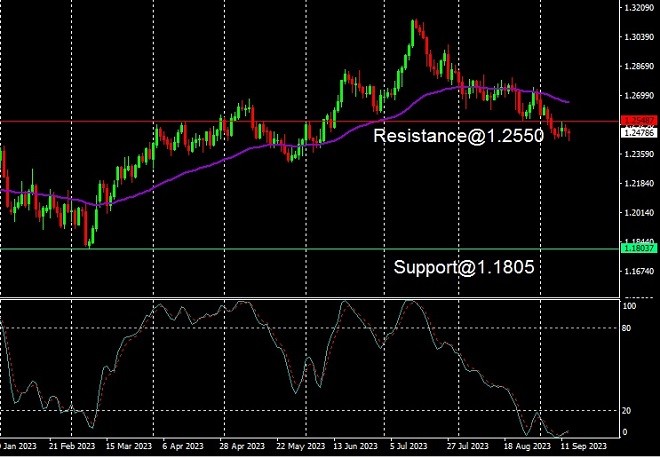
The weak UK GDP data is expected to keep the GBP/USD pair bearish in the short term.
The historical price chart indicates that the GBP/USD pair is descending after facing resistance at 1.2550. The next major support is anticipated only near 1.1805. Additionally, the currency pair is trading below its 50-day moving average, while the stochastic indicator is in the bearish zone. Therefore, we anticipate the GBP/USD pair to remain in a downtrend in the near term.
Disclaimer: Any financial trading analysis offered here is our opinion and is not intended as advice or direction for investors. We cannot guarantee the success of any trades made as a consequence of this article, and we encourage traders to incorporate a strong money management strategy to limit losses when they enter the markets. Please use this article as part of your own research before formulating strategies prior to trading.