
Earlier this week, the EURNZD pair started declining after news broke out that Italy’s next Prime Minister will be Giuseppe Conte, who is backed by the Five Star Movement (M5S) and the far-right. Both parties have an anti-EU stance and have openly expressed their plans to break away from the EU. The Kiwi dollar strengthened after New Zealand Prime Minister Jacinda Ardern’s maiden full-year budget laid to rest concerns over the government’s ability to demonstrate fiscal prudence. We expect the EURNZD pair, which is currently trading at 1.6910, to decline further due to the arguments presented below.
According to IHS Markit, Eurozone flash manufacturing PMI declined to 55.5 in May, from 56.2 in April, and below analysts’ estimates of 56.1. Likewise, flash services PMI fell to 53.9 in May, from 54.7 in the previous month. Economists were expecting the flash services PMI to remain unchanged. The PMI survey data indicated an overall slowdown in economic activity. The survey also indicated that companies have become less optimistic about the outlook.
In the Eurozone, both Germany and France recorded a decline in the flash services PMI to 52.1 and 54.3 in May, respectively, from 53 and 57.4 in the previous month. The services PMI figures missed analysts’ expectations as well.
In New Zealand, the dairy season ended on a high, with the GDT index rising 1.9% to reach $3637. Of the seven auctions conducted from February 20th, the average price of dairy products increased only in two auctions, including the latest. Therefore, it is a welcome relief for the farmers.
Concerns over possible large scale borrowing by the present government and rising yields in the US had triggered a sell-off that caused the Kiwi to lose as much as 7% between April 17th and May 23rd. However, the recent budget has alleviated those concerns. Therefore, considering the sharp decline in the recent past, Morgan Stanley has issued a report asking its clients to get “tactically bullish” as a probable reversal is on the horizon.
When investment banks caution about an impending reversal, it usually leads to large scale winding of positions (short, in this case). All the facts discussed above indicate the EURNZD pair will decline further in the week ahead.
Technically, the EURNZD pair has broken the support at 1.7070. The next major support exists only at 1.6710. Furthermore, the accumulation/distribution indicator is making new lows. Therefore, we are expecting the EURNZD pair to move down in the short-term.
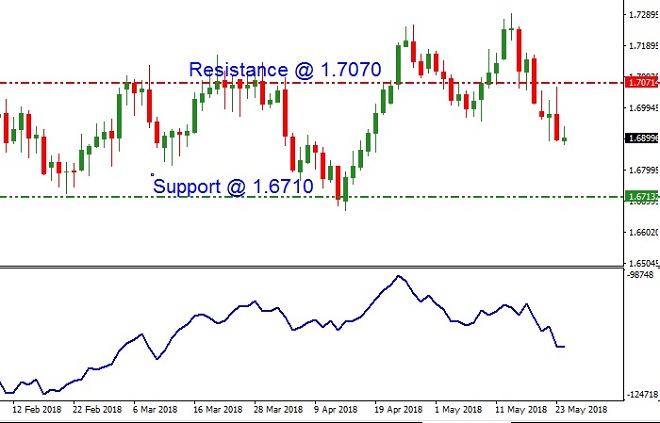
Using one of our trading accounts in the Forex market, we are planning to go short in the EURNZD pair near 1.6910, with a stop-loss order above 1.7020. If the currency cross declines as expected, then we would consider booking profit near 1.6710.
Likewise, in the binary market, we may invest in a put option contract, which expires on or around May 31st. The contract may be bought only if the currency cross trades near 1.6910 in the spot Forex market.
Disclaimer: Any financial trading analysis offered here is our opinion and is not intended as advice or direction for investors. We cannot guarantee the success of any trades made as a consequence of this article, and we encourage traders to incorporate a strong money management strategy to limit losses when they enter the markets. Please use this article as part of your own research before formulating strategies prior to trading.