
The euro remained range-bound against the loonie yesterday following the release of weak economic data from both the Eurozone and Canada. The manufacturing PMI data for Germany (and the Eurozone) and Canada reflected a contraction in economic activity in December. This kept the EUR/CAD pair within a narrow range of between 1.4549 and 1.4631in the past 24 hours.
The Hamburg Commercial Bank (HCOB) and S&P Global German Manufacturing PMI (purchasing managers’ index) improved to an eight-month high of 43.30 in December from 42.60 in November. The preliminary estimates had pegged the reading at 43.10. Economists did not anticipate any change in the preliminary reading, which reflected the fifth successive monthly increase. However, a reading below 50 indicates contraction, and vice versa.
Also, the HCOB German manufacturing PMI output index fell to a two-month low of 43.80 in December from 44.20 in November.
The weak manufacturing PMI was led by a fall in fresh orders but at the slowest pace since April 2022. As new orders declined, manufacturers recorded a decrease in backlogs of work, but at the slowest pace in seven months. Yet again, manufacturers slashed their workforce in December to counter a fall in capacity utilization. Notably, the third consecutive monthly rise in expectations resulted in sentiment turning positive for the first time since April 2022.
The HCOB and S&P Global Eurozone Manufacturing PMI hit a seven-month high of 44.40 in December from 44.20 in November. The preliminary estimates had pegged the reading at 44.20. Economists did not anticipate any change in the preliminary reading.
However, the HCOB Eurozone manufacturing PMI output index declined to a two-month low of 44.40 in December from 44.60 in November.
Fresh orders declined as demand for Eurozone goods fell yet again. However, the decline was at the slowest pace in seven months. Fresh orders from overseas clients also declined. Order backlogs decreased, underscoring another month of space capacity in the Eurozone manufacturing sector. Employment fell, in accordance with the trend that began last June.
As a whole, manufacturers in the Eurozone expressed the highest level of confidence in their production outlook since April of the previous year.
The S&P Global Canada manufacturing PMI (purchasing managers’ index) declined to 45.40 in December, reflecting the lowest reading since May 2020, from 47.70 in November.
Export orders experienced their most significant decline in three and a half years, coinciding with reported global conflicts that adversely affected the demand for manufacturing on a global scale. Simultaneously, the reduction in input inventories reached its most pronounced level in three and a half years.
Likewise, employment dipped to the highest level since June 2020. The availability of excess capacity, leading to a reduction in order backlogs, is also a reason for the fall in employment. Looking forward to the upcoming 12 months, firms have an optimistic view of recording an increase in production.
The weak economic data from both Europe and Canada is expected to keep the EUR/CAD pair range-bound in the near term.
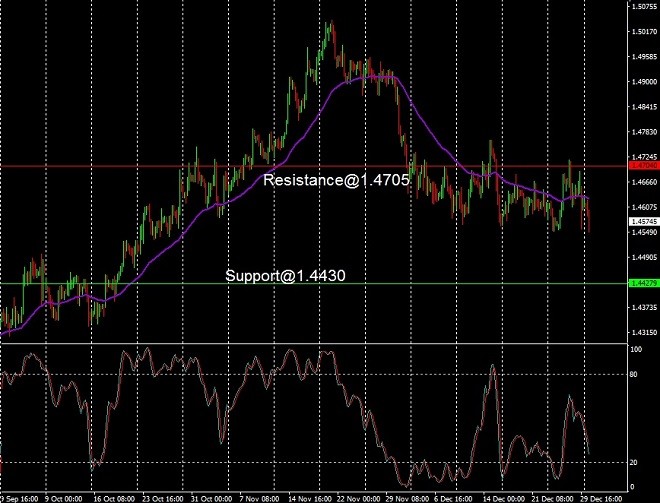
The historical price chart indicates that the EUR/CAD pair is declining after facing resistance at 1.4705. The next major support is anticipated only near 1.4430. Additionally, the currency pair is trading below its 50-day moving average, while the stochastic indicator is near the bearish zone. Therefore, we anticipate the EUR/CAD pair to remain in a downtrend in the near term.
Disclaimer: Any financial trading analysis offered here is our opinion and is not intended as advice or direction for investors. We cannot guarantee the success of any trades made as a consequence of this article, and we encourage traders to incorporate a strong money management strategy to limit losses when they enter the markets. Please use this article as part of your own research before formulating strategies prior to trading.