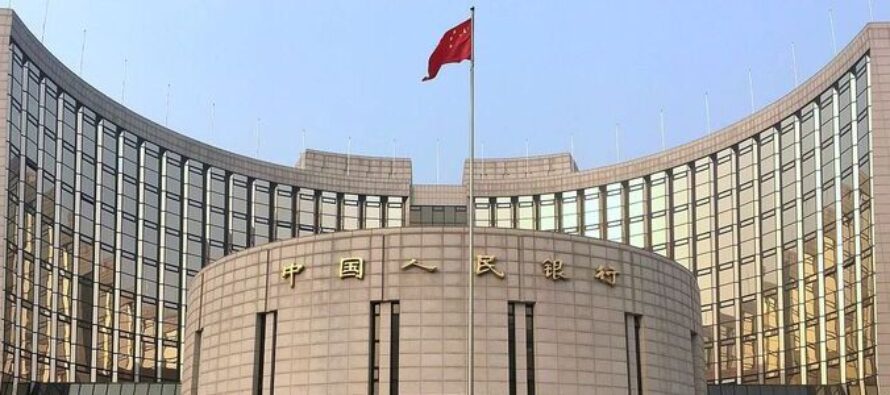
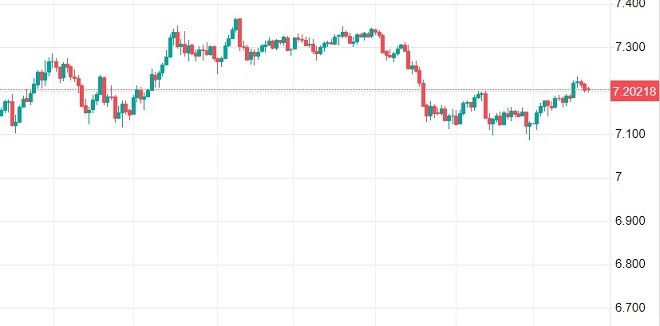
The offshore yuan, as an outcome of a subdued market response, stabilized around 7.20 per dollar on the first trading day of the week following the decision by China’s central bank (PBoC) to leave the benchmark lending rates unchanged, contrary to a section of market participants’ anticipations for another round of policy easing.
Specifically, the People’s Bank of China (PBoC) chose to leave the one- and five-year loan prime rates unaltered at 3.45% and 4.2%, respectively, during its January meeting. The latest revelation that China’s economic growth in the fourth quarter was below forecasts fueled speculations of potential strong policy measures by Beijing to bolster the economy.
Analysts believe that the limited flexibility of the central bank in adjusting monetary policy stems from the yuan’s fresh depreciation. Evidently, the yuan faced additional pressure due to a stronger greenback, ascribed to robust US economic data and hawkish signals from the Federal Reserve, which softened expectations for a rate cut in March. The analysts still believe that a certain level of monetary easing will be implemented by the central bank in the months ahead. It can be remembered that a few weeks before, the PBoC announced its decision to maintain the one-year medium-term lending facility rate at 2.5%.
The Conference Board’s leading economic index for the US inched down 0.10% m-o-m in December to 103.10, following a 0.50% decrease in the previous month and slightly better than forecasts of a 0.30% drop. In the six months ending December 2023, the leading economic index dipped by 2.90% compared with a 4.90% decline recorded in the earlier six months.
Justyna Zabinska-La Monica, Senior Manager, Business Cycle Indicators, at The Conference Board. “Despite the overall decline, six out of ten leading indicators made positive contributions to the LEI in December. Nonetheless, these improvements were more than offset by weak conditions in manufacturing, the high interest-rate environment, and low consumer confidence.”
Also, the Conference Board coincident economic index (CEI) for the US inched up 0.20% m-o-m in December to 111.70, following a 0.20% rise in the earlier month. The coincident economic index increased 1.10% in the month ending December, an increase from 0.80% growth recorded in the earlier six months.
However, the US Conference Board’s lagging economic index (LAG) inched down by 0.2% m-o-m in December to 118.4, partly reversing a rise of 0.5% in November.
The decision to maintain benchmark lending rates is expected to keep the yuan slightly weak against the greenback in the short term.
Disclaimer: Any financial trading analysis offered here is our opinion and is not intended as advice or direction for investors. We cannot guarantee the success of any trades made as a consequence of this article, and we encourage traders to incorporate a strong money management strategy to limit losses when they enter the markets. Please use this article as part of your own research before formulating strategies prior to trading.