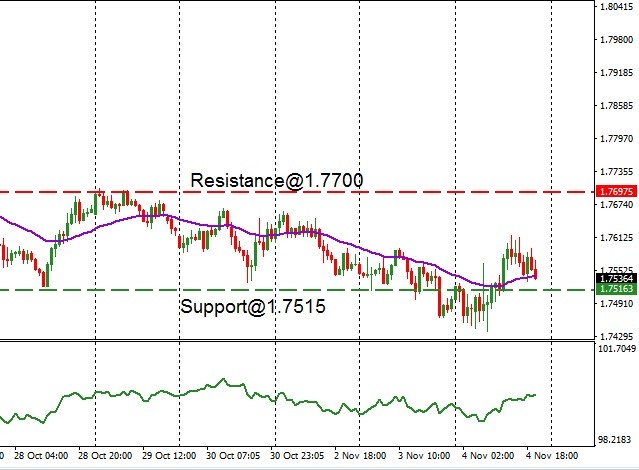
The New Zealand dollar declined slightly against the euro-dollar following the report of poor employment data by Statistics New Zealand. The Kiwi dollar’s decline was also aided by the better-than-anticipated Spanish, German, and the Eurozone services PMI data. Notably, the Eurodollar was unable to gain huge ground against the New Zealand dollar because the services PMI data only indicated contraction, albeit at a slower rate than anticipated. In the last 24 hours, the EUR/NZD pair traded between a low of 1.7440 and a high of 1.7610.
According to Statistics New Zealand, the number of unemployed people increased 37,000 (q-o-q basis) to reach 151,000 in the September quarter, primarily due to the negative impact of the COVID-19 pandemic. This translates to a 32.5% increase in unemployed people from the June quarter. Furthermore, the 37,000 increase is the largest quarterly rise in unemployment since the organization started publishing the series in 1986.
Correspondingly, the unemployment rate increased to 5.3% in the September quarter, from 4% in the June quarter. The reported unemployment rate, reflecting the biggest quarterly increase, was in line with analysts’ estimates.
The labor cost index increased 0.4% q-o-q in the third quarter, following an increase of 0.2% in the June quarter. Economists had anticipated the labor cost index to increase 0.2% in the September quarter.
Sean Broughton, senior manager for the labor market and household statistics, said, “We are continuing to see the economic effects of COVID-19, and its associated border and business closures. 151,000 is the highest number of unemployed people we have seen in eight years.”
The employment rate stood at 66.4% at the end of the September quarter, down from 67.1% in the earlier quarter, but it continues to stay at high levels in comparison with the post-2008-09 financial crisis period.
The underutilization rate was 13.2% in the September quarter, reflecting the highest level since March 2016 quarter. The underutilization rate stood at 12% in the prior quarter.
Finally, the labor cost index (LCI) salary and wage rates rose by 1.9% y-o-y in the September quarter. The annual public sector and private sector wage inflation was 2.6% and 1.6%, respectively.
In Europe, data provided by IHS Markit indicated that Spanish services PMI (purchasing managers’ index) declined to 41.40 in October, from 42.40 in the earlier month, but surpassed the reading of 40 anticipated by economists. A reading below 50 indicates contraction and vice-versa. It is the lowest recorded reading since May.
The survey participants stated that the COVID-19 pandemic was the main reason for the decline in new business. Obviously, the tourism sector reported a severe impact. Fresh export orders declined for the 18th consecutive month and also in October.
Concerning the outlook for the upcoming 12 months, business confidence improved to the highest level since June.
According to IHS Markit, Italian services PMI fell to 46.70 in October, from 48.80 in the prior month, and missed the reading of 47.40 anticipated by economists. The weak demand environment continued to impact services activity as new business recorded a decline for the eighth month in a row and at the fastest rate since June. Additionally, the rate of job losses accelerated. Overseas demand for Italian services also declined in a remarkable manner because of the fresh round of lockdown measures implemented across the globe.
With respect to the outlook for the forthcoming 12 months, the country’s service providers had a favorable view.
In a separate news release, the IHS Markit stated that German final services PMI declined to 49.50 in October, from 50.60 in September. The reported figure was slightly above the preliminary (flash estimate) reading of 48.90. Economists anticipated no change in the flash estimate.
For the first time in four months, business activity recorded a decline. Fresh lockdown prohibitions and the reluctance of clients affected demand. Despite a drop in confidence, employment rose slightly. As anticipated, hotels & restaurants recorded the largest decline in activity in October. Transport & storage and financial services sector also posted a drop in activities.
The German composite output index inched upwards to 55 in October, from 54.70 in September. The increase was mainly due to a continuous rise in manufacturing production, partially offset by a drop in services activity on a m-o-m basis.
The sentiment regarding output for the upcoming 12 months weakened to the lowest level since June. Manufacturing anticipations also eased slightly but remained positive.
The Eurozone final services PMI declined for the second consecutive month to 46.90 in October, from 48 in September, but higher than the flash estimate of 46.20. Economists had anticipated no change in the flash estimate. The reported reading is the lowest level since May.
Manufacturing output growth continued to reach the strongest level in more than two-and-a-half-years. On the contrary, service sector activity shrank again, declining to the steepest level since May.
Notably, new business declined for the first time in four months. Exports rose for the second month in a row.
For the 20th consecutive month, backlogs of work recorded a decline, even though the rate of shrinking was minimum and feeble since February.
Regarding the outlook for the next 12 months, business sentiment was positive but declined to the lowest level since May.
Commenting on the Eurozone services PMI data, Chief Business Economist at IHS Markit, Chris Williamson, said, “The eurozone’s economic recovery stalled in October as containment measures were stepped up to fight second waves of COVID-19 infections. Service providers have been hit especially hard, led by intensifying weakness in consumer-facing sectors such as hospitality, offsetting the brighter news seen in manufacturing during the month.”
The weak New Zealand and Europe economic data are expected to keep the EUR/NZD pair range-bound with a slight bullish bias in the short-term.
The price chart indicates that the EUR/NZD pair is ascending after testing support at 1.7515. The next resistance is anticipated only near 1.7700. The momentum indicator is also rising. Therefore, we are expecting the currency pair to remain slightly bullish in the near-term.
Disclaimer: Any financial trading analysis offered here is our opinion and is not intended as advice or direction for investors. We cannot guarantee the success of any trades made as a consequence of this article, and we encourage traders to incorporate a strong money management strategy to limit losses when they enter the markets. Please use this article as part of your own research before formulating strategies prior to trading.