Europe’s most valuable software company SAP SE (SAP.XE) reported fiscal 2018 fourth-quarter results that exceeded analysts’ estimates. The company also pointed out that it has met or surpassed Wall Street estimates mainly due to double-digit growth in the cloud segment. Still, the stock lost 4.39% to close at €89.59 due to concerns over the company’s restructuring plan. With this decline, the stock has dropped nearly 5% in the past three months. SAP has a market cap of €108 billion.
SAP announces restructuring plan to prop up slowing business divisions
The German software giant posted Q4 2018 IFRS revenues of €7.428 billion, up 9% from €6.805 billion in the prior-year period. Non-IFRS revenues were €7.434 billion in 4Q18, an increase of 13% from €6.807 billion in 4Q17.
For the quarter ended December, earnings on an IFRS basis were €1.692 billion, or €1.41 per share, down 9% from €1.864 billion or €1.54 per share in the similar quarter last year. On a non-IFRS basis, Q4 2018 earnings dropped 15% to €1.803 billion, from €2.133 billion in the comparable period last year.
The FactSet analysts had anticipated SAP to report a profit of €1.52 billion on revenues of €7.25 billion in the fourth quarter. Operating profit jumped 22% year-over-year to €2.4 billion IFRS.
The cloud subscriptions and support revenue soared 41% y-o-y to €1.41 billion. New cloud bookings increased 25% to €736 million. Business software revenue was up only 1% y-o-y to €2.09 billion (IFRS basis). Put together, cloud and software revenue increased 9% to €6.32 billion (IFRS basis).
Commenting on the results, Luka Mucic, CFO said, “New order entry surged 18% in Q4, taking the total for the full year to over €10 billion for the first time ever. This stellar business momentum sets us up perfectly for continued strong, profitable growth in 2019 and beyond, while we expect our cloud growth will continue to outperform our business software cloud peers.”
All three primary business segments of SAP namely “Applications, Technology & Services,” “Customer Experience” and “SAP Business Network” performed well in the fourth quarter.
While Applications, Technology & Services division generated revenues of €6.26 billion, up 6% on a year-over-year basis, the Customer Experience segment reported revenues of €349 million, an increase of 52% year-over-year. The SAP Business Network category reported Q4 revenues of €721 million, up 26% percent year-over-year.
SAP also announced that it would take restructuring charges of between €800 million and 950 million in the first quarter. Due to restructuring, the company expects the cost benefits of €750 million to €850 million from 2020.
Regarding restructuring, CEO Bill McDermott said: “The earlier you do it in the year, the more benefit you get in the performance of the company, as you know, in the back end of the year. So change when you’re very strong, that’s what we do.”
The company anticipates revenues to “increase strongly” in FY19, with cloud subscriptions and support revenue growing between 33% and 39% to €6.70 billion and €7 billion.
Regarding FY19, McDermott said, “We are going to triple our cloud business between now and 2023 so by far we are gaining market share, and we are the number one business software company in the world.”
The facts presented above indicate that the market may react negatively to the stock in the short-term, mainly due to the enormous costs that would be spent on restructuring.
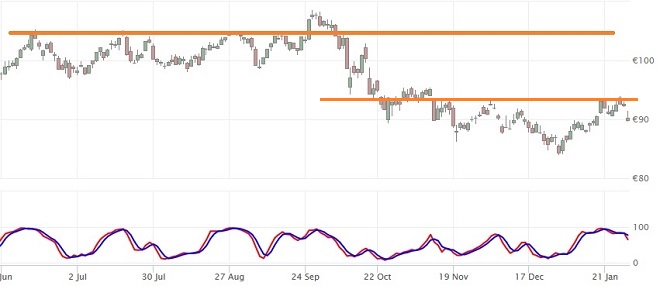
Technically, the stock is facing resistance at 95 levels. Furthermore, the stochastic oscillator has started declining from the overbought region. As a result, we can expect the stock to remain bearish in the short-term.
Disclaimer: Any financial trading analysis offered here is our opinion and is not intended as advice or direction for investors. We cannot guarantee the success of any trades made as a consequence of this article, and we encourage traders to incorporate a strong money management strategy to limit losses when they enter the markets. Please use this article as part of your own research before formulating strategies prior to trading.