

Following the latest rules of the US Treasury to restrict merger (inversion) deals intended to reduce tax, the $160 billion merger (biggest in the history of the pharmaceutical industry) of Pfizer and Allergan was called off on Wednesday. However, the market reacted positively to lift the share price of Pfizer to a high of $32.8. At the outset, the uptrend may look odd to a trader, but a study of the company’s fundamentals will reveal that Pfizer would be little affected by calling off the merger deal.
Earlier in November 2015, Pfizer confirmed its merger with Allergan. Through the inversion deal with Allergan, Pfizer hoped to bring down its tax obligation from 25% to 17%. This would result in cost savings of up to $1 billion per annum. In order to protect the country’s interests, the US Treasury brought in new rules to restrict firms from involving in inversion deals.
According to the new rule, stocks that were accumulated by the overseas company in the past three years will not be taken into consideration for the calculation of the book value. In the past three years, Allergan was involved in several deals including the $66 billion merger with Actavis Plc, the $25 billion acquisition of Forest Laboratories, and the $5 billion purchase of Warner Chilcott.
Ultimately, any change in terms to complete the deal would negate all the tax benefits. Thus, Pfizer, which was not in favor of changing the deal terms, officially withdrew from the deal. According to the signed merger agreement, Pfizer should pay about $400 million for the termination of the deal.
Still, considering the past record of Pfizer, a trader can expect the company to go in for another suitable acquisition. The company acquired Warner-Lambert in 2000, Pharmacia in 2003, Wyeth in 2009, and Hospira in 2015. The Warner-Lambert deal was mainly done to have control over the Lipitor drug. In 2013, the company lost its exclusive rights over Lipitor, and this is expected to hurt the company’s revenue. Thus, Pfizer would be aggressively looking for acquisitions to boost revenue growth. Alternatively, the company would either sell or spin off its generic medicines.
The company has $43 billion in current assets. However, the debt is only $28 billion as indicated by the 10-K form filed in February. In fiscal 2015, Pfizer had repurchased stock worth $6 billion and paid $6 billion as dividends. Thus, fundamentally, the stock remains bullish.
The MACD indicator, with its mainline above the zero line and rising, indicates that the share price of Pfizer is on an uptrend. The share price can be expected to touch the 34-35 zone where the major resistance lies. On the downside, support exists at 30.50.
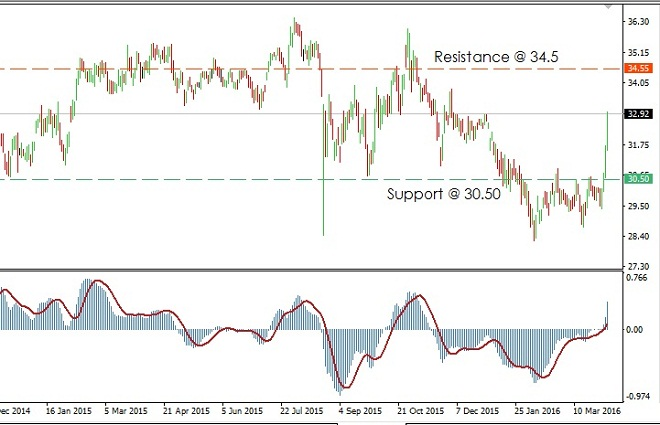
Under these circumstances, a call option contract can be purchased to capitalize on the price movement. Being a trade based on news, a trader should look for a short-term contract expiring in the second or third week of April. Needless to say that the target level or the strike price of the contract should be near $35 levels.
Disclaimer: Any financial trading analysis offered here is our opinion and is not intended as advice or direction for investors. We cannot guarantee the success of any trades made as a consequence of this article, and we encourage traders to incorporate a strong money management strategy to limit losses when they enter the markets. Please use this article as part of your own research before formulating strategies prior to trading.


