
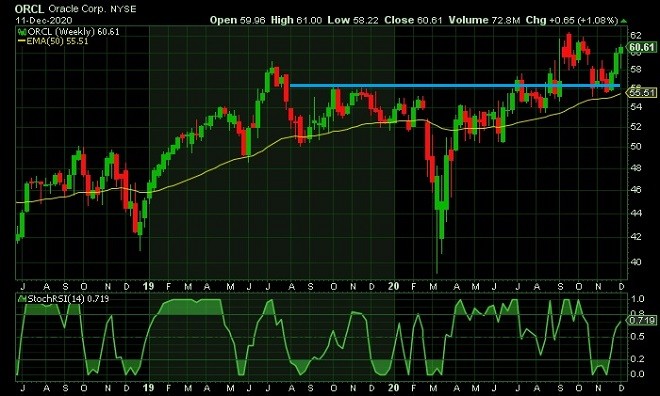
Information technology giant Oracle Corp (NYSE: ORCL) posted better-than-anticipated fiscal 2021 second-quarter results, aided by the cloud services division’s impressive performance that paved the way for a 2% increase in revenue. The rest of the four divisions posted negative growth. Since the beginning of this year, the shares of Oracle have been appreciated by 12%. Following an impressive Q3 outlook, the stock gained 1.90% or $1.13 to close at $60.61.
The Redwood City, California-based Oracle, reported second-quarter revenues of $9.80 billion, compared with $9.61 billion in a similar period last year. Analysts had anticipated the company to post revenues of $9.79 billion for the second quarter.
For the quarter ended November 30th, 2020, the company posted a $2.442 billion net income, or $0.80 per share, compared with $2.311 billion, or $0.69 a share, in the prior-year period.
Excluding one-time charges, Oracle recorded 2Q 2020 adjusted earnings of $3.235 billion or $1.06 per share, compared with $2.981 billion, or $0.90 a share, in the year-ago period. Analysts polled by Refinitiv had anticipated the company to report earnings of $1 per share.
Oracle stated that the work at home phenomena had caused an increase in demand for its cloud services that fueled overall revenue growth.
Commenting on the small revenue growth, Larry Ellison, Oracle’s co-founder, and chairman said, “We would have had more revenue growth if we had not been capacity-constrained in OCI during Q2.”
The chairman’s statement points to the company’s cloud framework, which rivals Microsoft’s Azure and AWS (Amazon Web Services).
The Covid-19 pandemic negatively impacted the traditional business services offered by the company.
Segment-wise,
- Cloud services and license support posted $7.11 billion in revenue, increasing 4% on a y-o-y basis. Economists surveyed by FactSet had anticipated revenues of $7.04 billion. Interestingly, as per Safra Catz, CEO of Oracle, infrastructure revenue increased 139% in 2Q 2021.
- Cloud license and on-premise license revenues were $1.092 billion, down 3% from last year. FactSet analysts had anticipated revenue of $1.13 billion.
- Hardware revenues fell by 3% y-o-y to $844 million but surpassed the $838 million revenue anticipated by analysts polled by FactSet.
- Services revenues were $752 million, compared with $806 million in the prior-year period. The reported income was $2 million above the consensus estimate of $750 million.
Regarding the impact of the Covid-19 pandemic, Catz said: “So the pandemic affects us in some ways negatively, in some ways positively, simply because of our size and breadth of customer base, it affects them differently.“
During the second quarter, the US President Donald Trump stated that he is willing to give the green light for the deal involving the shift of US client info for video-based social networking platform TikT.
ok to Oracle’s cloud framework. The ERP (enterprise resource planning) service provider revealed that the deal, subject to regulatory clearances, involves acquiring a 12.5% stake in TikTok Global, a subsidiary of ByteDance Ltd., as a portion of the agreement.
The database technology provider also introduced a cloud-based service that entities can utilize to track the robustness of various components of applications that function in clouds and onsite hubs.
In the future, Catz anticipates Oracle to generate adjusted earnings in the range of $1.09 to $1.13 per share in 3Q 2021. The company also expects yearly revenue growth of between 2% and 4%. Analysts surveyed by Refinitiv are forecasting adjusted earnings of $1.04 per share on revenues of $9.94 billion, implying a 1.5% growth.
The upbeat Q3 outlook is expected to keep the stock range-bound with a slight bullish bias.
The historical price chart indicates that the stock is ascending after consolidating at 65 levels. The stock is also trading above its 50-day moving average, while the stochastics RSI indicator is rising. Therefore, we are anticipating the stock to remain in an uptrend in the short-term.
Disclaimer: Any financial trading analysis offered here is our opinion and is not intended as advice or direction for investors. We cannot guarantee the success of any trades made as a consequence of this article, and we encourage traders to incorporate a strong money management strategy to limit losses when they enter the markets. Please use this article as part of your own research before formulating strategies prior to trading.