
The online e-commerce giant Amazon.com, Inc. (AMZN) briefly crossed the market cap of $1 trillion yesterday but closed with a market cap of about 994 billion. It is the third company in the world and second in the US to reach a market cap of $1 trillion. While Apple attained a market cap of $1 trillion a month before, Chinese oil giant PetroChina reached $1 trillion in 2007.
PetroChina eventually lost more than $800 billion to trade with a market cap of approximately $135 billion. In Amazon’s situation, the company has been focusing on the bottom line, rather than on their top-line, over the past year, which has made an enormous difference, not only in their quarterly results but also on the stock price, which last traded at $2,039.51.
Amazon’s astonishing market dominance
The Seattle, Washington-based company receives $0.49 of every e-commerce dollar spent in the US. The company generates annual revenue of about $178 billion and employs more than 550,000 people. The company sells over 200 million products in the USA, which are categorized into 35 divisions – with almost 5 million items in the Clothing department, nearly 20 million in Sports & Outdoors, and over 4 million in Office Products.
The market cap of $1 trillion may be regarded as an arbitrary threshold, but one cannot deny the remarkable growth of the 24-year-old company and endless confidence investors have in its future. Put in perspective, the market cap of all the 14 largest retailers based on fiscal 2017 revenues must be added to match the market cap of Amazon which includes companies such as Walmart (WMT) to AutoNation (AN). The stock of Amazon is also valued higher in comparison with focused grocery, retail, and building stocks, which had an average PE ratio of between 20 and 40 in 2017.
Up until last year, the stock rallied mainly due to the consistent top-line growth it reported every quarter. The company was pouring back a major portion of its revenues into other businesses (acquiring companies, etc.,) and to strengthen its delivery (developing new technologies and establishing fulfillment centers) framework.
The valuations were high, but certainly not to the extent of what it is now. In January 2018, Amazon was worth only $580 billion, but the valuations started skyrocketing when the company reported a net profit of $2.5 billion in the 2Q18, an impressive increase from $197 million in the similar period of 2017.
The company’s cloud computing business, Amazon Web services, mainly contributed to the success and revenue from prime membership subscriptions and the advertisements it sells across its sites continues to drive up margins.
The manner in which Amazon flexes its muscles has dramatically increased analysts and investor’s interest in the stock. Morgan Stanley has recently raised the price target to $2,500, and this price level would take Amazon’s market cap to $1.2 trillion, based on revenue growth guidance of 24% per year through 2020.
Morgan Stanley has valued Amazon Web Services, now an omnipresent layer of the internet that aids enterprises ranging from small startups to the Central Intelligence Agency, at $375 billion. With this price rise, the company has also broken the myth that its value is built on hype and is an overpriced stock.
Daniel Martins, who heads an independent research firm, has commented about Amazon’s valuation as follows: “It’s too high of a bar to assume that they’ll succeed at everything that they do,” Martins says. “But at the same time, I think Amazon is the best combination in the world of the scale of a large company and that entrepreneurial DNA with the spirit of a startup.”
Amazon remains appealing to investors because of its ability to speedily transfer a product from one point to another, and also the fact that it dominates any business sector through its unique approach using its skills in data analysis.
Many argue that antitrust regulators may scrutinize Amazon’s strategy in the future. It should be noted that antitrust regulators will investigate a firm when they believe that the cost of a product would increase based on a business dominance of a company. In Amazon’s case, the value of commodities has only gone down, and thus the strategy is not seen as harmful by regulators. We can, therefore, expect the stock to remain in the bullish trajectory in the foreseeable future.
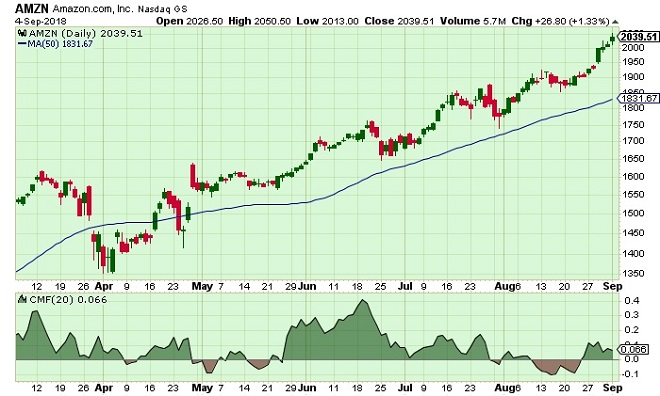
Technically, the stock is trading above its 50-day moving average, and the Chaikin money flow indicator is in the positive region. A continuation of the current uptrend, albeit with minor corrections, can, therefore, be expected.
Disclaimer: Any financial trading analysis offered here is our opinion and is not intended as advice or direction for investors. We cannot guarantee the success of any trades made as a consequence of this article, and we encourage traders to incorporate a strong money management strategy to limit losses when they enter the markets. Please use this article as part of your own research before formulating strategies prior to trading.