
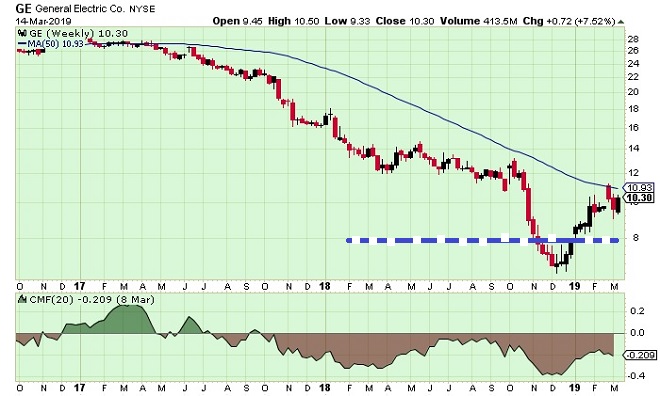
Yesterday, the CEO of General Electric Company (NYSE: GE), Larry Culp, revealed the company’s outlook for 2019, 2020 and 2021. The details presented to investors through a conference call were not outright bullish. However, the particulars convinced investors that the company is on the right track and things are looking good for the years to come. Following the conference call, the stock gained 2.79% or $0.28 to end the day at $10.30.
GE stock boosted by outlook
While providing an update to investors, Larry Culp stated that it anticipates 2019 adjusted earnings of between $0.50 and $0.60 per share, a decline from $0.65 in 2018, and below the FactSet consensus of $0.70 per share. Adjusted industrial free cash flow (FCF) is forecast to range from negative $2 billion to flat in 2019. The cash flow outlook is an affirmation of the negative view issued by Culp’s call last week.
Commenting on the outlook, Culp said “GE’s challenges in 2019 are complex but clear. We are facing them head-on as we execute on our strategic priorities to improve our financial position and strengthen our businesses.”
JP Morgan analyst Stephen Tusa cautioned that negative cash flow “is not good” as believed by some investors on the basis of the argument that the outlook has “de-risked” the stock.
Furthermore, the company anticipates 2019 FCF for GE’s power division to decline or turn more negative than the -$2.7 billion reported for fiscal 2018. For 2020, the power segment is anticipated to perform “significantly better but negative.”
Specifically, within the power segment, GE divulged that its gas business is beginning to see an improvement, but will take several years to ward off all issues and put up an impressive performance. The company further revealed that it is aiming for an 11% reduction in base costs to $3.2 billion in 2019. For 2020, the company hopes to achieve another 13% reduction in base costs to $2.8 billion.
Culp acknowledged that power division had been poorly managed for the past several years and the management took time to understand and change the strategy in tune with market realities. Culp believes that the company was slow to resolve issues related to operational costs because of these inefficiencies.
Culp, however, stated that the business is in “serious turnaround mode,” even though “this is not going to be quick.”
In a separate announcement, GE stated that it stays dedicated to a financial approach that aims for a credit rating in the single-A range, reflecting a notch above the current BBB+ rating issued by S&P Global Ratings.
The company indicated that it would not perform well this year, primarily due to the struggling power segment. However, GE is confident of a turnaround next year, with further improvement in performance by 2021.
Notably, the stock fell by roughly 4.5% in premarket trade as the company’s presentation was made available. It then reversed sharply as investors understood the long-term positive impact of the plan. As the outlook is neither too bullish nor bearish, the stock may remain range-bound in the short-term.
As the price chart indicates, the stock is trading below its 50-day moving average. However, it has bounced off the support at 8. The Chaikin money flow indicator has a negative reading. But the indicator is moving towards the zero level which indicates an impending trend change. Therefore, it is advisable to open a long position near the support level (8) or take a short position near the 50-day moving average, with stop loss orders.
Disclaimer: Any financial trading analysis offered here is our opinion and is not intended as advice or direction for investors. We cannot guarantee the success of any trades made as a consequence of this article, and we encourage traders to incorporate a strong money management strategy to limit losses when they enter the markets. Please use this article as part of your own research before formulating strategies prior to trading.