
In early February, truck maker Volvo AB (STO: VOLV-B) reported a 86% y-o-y increase in the fiscal 2016 fourth-quarter earnings. However, the stock did not trend in any direction. One of the reasons for the lackluster response from the investors is the marginal decline in the fiscal 2016 revenue, compared with last year. Now, after a month of consolidation, the fundamentals and technical support a breakout in the stock as explained below.
The Stockholm-based company reported fiscal 2016 fourth-quarter revenues of Swedish Krona 82.56 billion, up from Swedish Krona 79.64 billion in the corresponding quarter last year. During the fourth quarter of 2016, the net income increased to SEK 4.83 billion or SEK 2.37 per share, from SEK 2.60 billion or SEK 1.27 per share in the fourth quarter of 2015.
Excluding charges, which include a capital gain from the sale of property amounting to SEK 1.37 billion, adjusted operating income for 4Q16 increased to SEK 5.67 billion, from SEK 4.57 billion in 4Q15. The FactSet analysts expected a net profit of SEK 3.92 billion on revenues of SEK 78.34 billion. During the recent quarter, the adjusted operating margin increased to 6.9%, from 5.7% in the same period of 2015.
The company, which owns brands such as Volvo, Renault, Mack, and UD, continues to trim production in North America, where there is plenty of used trucks on the offering. However, considering the decline in new inventories, Volvo anticipates the North American market to stabilize in the months to come. Volvo stated that the number of truck orders intake during the fourth-quarter increased to 53,950, from 49,088 in the prior-year quarter.
Similarly, the number of construction equipment orders were 13, 276 in the fourth-quarter 2016, versus 9,844 in the fourth-quarter 2015. The company also raised its fiscal 2017 truck sales estimate to 300,000 vehicles, from the prior guidance of 280,000. For fiscal 2016, Volvo announced a dividend of SEK 3.25 per share, up from the prior-year dividend of SEK 3.00 per share. Thus, considering the impressive earnings and positive outlook for fiscal 2017, fundamentally, the stock is expected to remain in an uptrend.
The price chart indicates that buyers are giving support to the stock near the level of 13. The stochastic RSI indicator is on the verge of breaking into the bullish zone. So, technically, there exists a high probability of a rally in the stock of Volvo.
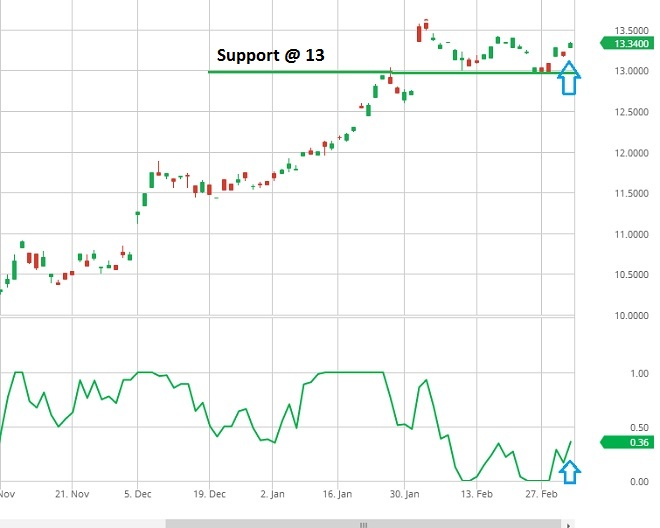
A trader can bet on the increase in the stock price by investing in a call option offered by a binary broker of choice. By timing the entry near $13 and selecting an expiry date around March 15th, a trader can hope to gain from the probable appreciation of the stock.
Disclaimer: Any financial trading analysis offered here is our opinion and is not intended as advice or direction for investors. We cannot guarantee the success of any trades made as a consequence of this article, and we encourage traders to incorporate a strong money management strategy to limit losses when they enter the markets. Please use this article as part of your own research before formulating strategies prior to trading.