Tesla Inc.’s (Nasdaq: TSLA) shares recorded another multi-year low last Friday after a leaked document indicated that the Silicon Valley automaker is losing cash at a fast pace due to a lack of rigorous cost-control policies. The stock of Tesla Inc. commands a massive valuation compared to other automobile manufacturers, but analysts claim exaggerated valuation is turning out more difficult to defend.
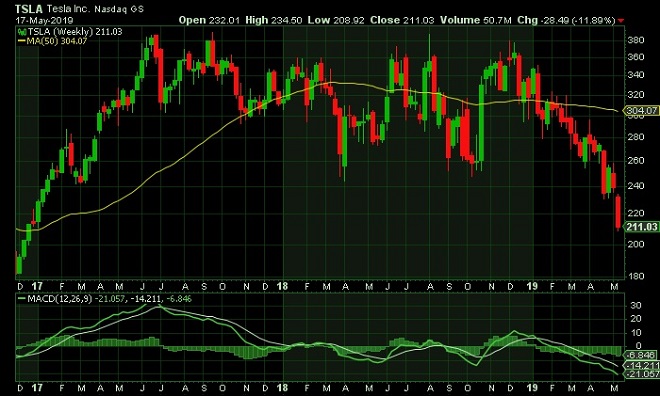
Tesla’s stock dropped 7.6% to end at $211.03 on Friday, its lowest close since December 22nd, 2016, when it finished at $208.45. The stock was Nasdaq 100’s second-worst performer with monthly losses rising above 11%. Over the past year, Tesla’s shares have dropped 21% and 31% so far in 2019. That compares with appreciations of over 5% and 14% for the S&P 500 and SPX, respectively, over the same period.
Tesla closed Friday’s trading session at $211.03, down $17.30 or -7.58% from the prior close.
Chief Executive Elon Musk supposedly informed workers that the $2.2 billion cash reserve of the firm “is a lot of money, but actually only gives us about 10 months at the first-quarter burn rate to achieve breakeven,” as per a study by a US-based news website dedicated to electric transportation and sustainable energy Electrek, citing a Musk’s email.
It is reported that Musk and Chief Financial Officer Zach Kirkhorn will personally check and allow all expenditures as a portion of a cost-cutting strategy, which involves examining all expenses, including wages and transportation costs. Kirkhorn will check each payment sheet, and Musk will evaluate every fifth page himself, reported Electrek. “This is hardcore, but it is the only way for Tesla to become financially sustainable,” Musk wrote.
Earlier in May, Tesla raised funds via capital markets. The enterprise ended 1Q19 with $2.2 billion in cash, $1.5 billion lower than at the beginning of 2018, partly due to a $920 million convertible bond loan in March. In April, the firm recorded a wider-than-anticipated first-quarter net loss, while the revenues were below the Wall Street estimates.
Analysts have pointed out that Tesla’s enterprise value, hovering around $53 billion, is considerably higher than established profit-making automakers such as Volkswagen AG (VOW-$36 billion) and BMW AG (BMW-$15 billion).
Regarding the valuation, analysts at Evercore ISI said, “The only thing that can justify such valuations is supernatural growth and best in class execution. Both are in question right now.”
Analysts, guided by Arndt Ellinghorst, head of the London Office and Head of Global Automotive Research for ISI Group, said: “Tesla is a car company. It needs and burns cash like a car company. The longer questions around execution and growth persist, the more difficult the valuation is to defend.”
Evercore anticipates approximately 343,000 vehicle shipments in 2019 relative to their previous forecast of 368,000 automobiles and a consensus estimate of roughly 364,000 cars. Tesla’s 2019 delivery estimates range from 360,000 to 400,000.
Regarding production delays and demand, Evercore analysts said: “We are relatively sanguine around near-term demand for Model 3, but given continued and persistent delays around battery production, (Tesla) will have to prove their ability to dramatically scale production across multiple models to reach their lofty aspirations (and Q2 guidance).”
In addition, experts said they anticipate Model 3 to reach maximum sales volumes in 2020, three years after introduction, and with prospective obsolescence due to the introduction of Model Y – the subcompact SUV Tesla is planning to Introduce in 2021.
Based on the arguments mentioned above, analysts at Evercore ISI downwardly revised their price target on Tesla’s shares to $200 from $240.
The leaked internal memo and analysts’ downgrade is expected to keep the stock bearish in the short-term.
Technically, the stock has broken the 50-day moving average. Furthermore, the MACD indicator is making new lows. As a result, we can expect the stock to remain bearish in the short-term.
Disclaimer: Any financial trading analysis offered here is our opinion and is not intended as advice or direction for investors. We cannot guarantee the success of any trades made as a consequence of this article, and we encourage traders to incorporate a strong money management strategy to limit losses when they enter the markets. Please use this article as part of your own research before formulating strategies prior to trading.