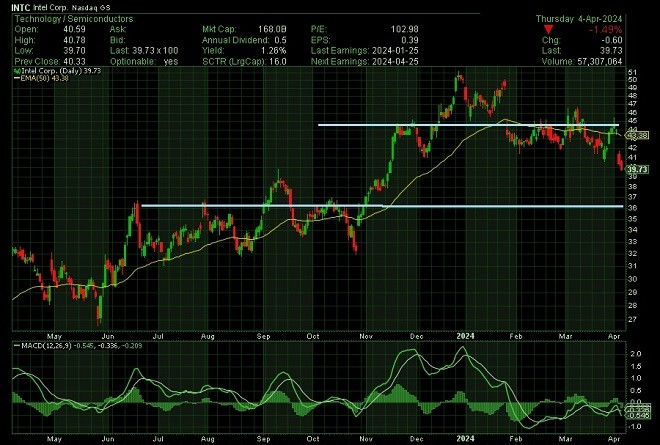
Intel Corporation (Nasdaq: INTC), through an SEC filing, provided detailed insight regarding its manufacturing operations, revealing a deepening of losses within its production facilities and indicating that the business will remain in a red zone for many years. The chipmaker presented a novel financial reporting format for its foundry operations, which revealed $7 billion in operating losses last year, a significant increase from the loss of $5.2 billion reported in 2022. The stock ended Thursday’s trading session at $39.73, down $0.60, or 1.49%, from the prior close.
This revelation underscores the challenges Intel faces in its attempt to reclaim the technological edge it once held over competitors like Taiwan Semiconductor Manufacturing. As part of an arduous turnaround strategy led by CEO Pat Gelsinger, the company is reorganizing its finances to provide a clearer picture of its foundry business, aiming to run it more distinctly. This restructuring is crucial as Intel endeavors to produce chips for diverse enterprises, necessitating a degree of spin-off from its core operations.
Despite pouring billions of dollars into the construction of new production facilities as part of its transformation efforts, Intel anticipates that this year will mark the peak of operating losses for its chip manufacturing business. Gelsinger outlined during an investor presentation that the company anticipates breaking even operationally only around 2027. Furthermore, Intel projects that its manufacturing unit will achieve profitability “midway between 2024 and 2030.”
The challenges faced by Intel’s foundry operations stem partly from past choices, including the reluctance to adopt extreme ultraviolet (EUV) machines manufactured by market-leading Netherlands-headquartered ASML. Gelsinger acknowledged that while this hardware entails significant upfront costs, it offers greater cost-effectiveness compared to previous chip-producing equipment. Intel’s strategy to step into outsourced chip manufacturing represents a fundamental shift for the company as it seeks to recapture its technological edge under Gelsinger’s leadership.
To address its shortcomings, Intel has begun adopting EUV tools, gradually phasing out outdated machines to improve production efficiency. Gelsinger reiterated his commitment to restoring Intel’s technological advantage, with plans to leverage advanced techniques like extreme ultraviolet lithography to enhance product capabilities and reduce manufacturing costs. This strategy aims to generate contract manufacturing deals from rivals and generate up to $15 billion in revenues in the final quarter of 2030.
Moreover, Intel has secured agreements with five enterprises to utilize its newest production methodology, known as 18A, signaling confidence in its technological capabilities. The company plans to ramp up production using these techniques, supported by a substantial investment of $100 billion in setting up or expanding semiconductor manufacturing factories across four states in the US.
Intel’s commitment to expanding its production capabilities is evident in its collaboration with Microsoft, whereby Intel Foundry Services (IFS) will manufacture tailor-made chips for the software behemoth. This partnership underscores Intel’s aggressive approach to securing contracts and expanding its presence in the semiconductor market.
Financially, Intel’s massive spending is reflected in its capital allocation of $43.4 billion at the end of December 2023, compared to $36.7 billion in the previous year. Notably, Lorenzo Flores has been appointed as the chief financial officer (CFO) of the foundry division, emphasizing Intel’s focus on strengthening its financial management to support its ambitious growth plans.
The weak performance report is expected to keep Intel’s stock slightly bearish in the short term.
The historical price chart indicates that the stock of Intel is declining after breaking the support level at $43. The next major support is anticipated to be only near $36. Additionally, the stock is trading below its 50-day moving average, while the MACD indicator is showing a negative reading. Therefore, we anticipate the stock price of Intel to remain in a downtrend in the short term.
Disclaimer: Any financial trading analysis offered here is our opinion and is not intended as advice or direction for investors. We cannot guarantee the success of any trades made as a consequence of this article, and we encourage traders to incorporate a strong money management strategy to limit losses when they enter the markets. Please use this article as part of your own research before formulating strategies prior to trading.