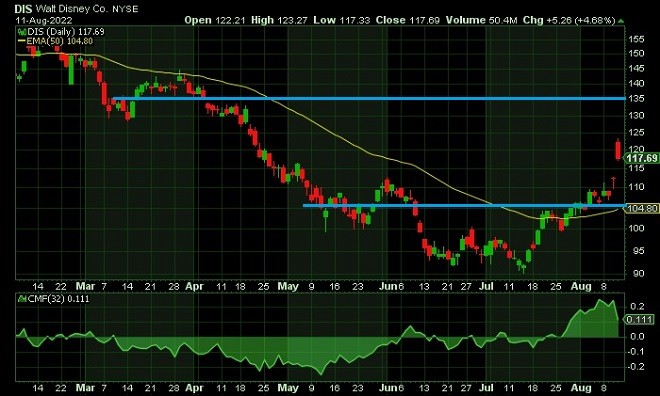
The entertainment company Walt Disney Co (NYSE: DIS) reported better-than-anticipated fiscal 2022 third-quarter earnings and revenues. More importantly, the company’s streaming subscriber additions not only surpassed analysts’ estimates but also eclipsed Netflix’s subscriber count. Following the impressive results, the stock rallied 4.68%, or $5.26, to close at $117.69.
Burbank, California-based Walt Disney reported third-quarter revenues of $21.50 billion, an increase of 26% from $17.02 billion in the similar period last year.
For the quarter ended July 2, 2022, the company posted a net income of $1.41 billion, or $0.77 a share, up from $918 million, or $0.50 a share, in the quarter ended July 3, 2021.
Excluding the amortization of TFCF and Hulu intangible assets and restructuring and impairment charges, among others, Walt Disney recorded Q3 2022 adjusted earnings of $2.087 billion, or 1.09 per share, compared with $1.687 billion, or $0.80 a share, in Q3 2021.
Analysts surveyed by Refinitiv had anticipated the company would post earnings of $0.96 per share on revenues of $20.96 billion.
Commenting on the latest quarterly results, Bob Chapek, CEO of The Walt Disney Company, said, “[…] with compelling new storytelling across our many platforms and unique immersive physical experiences that exceed guest expectations, all of which are reflected in our strong operating results this quarter.”
Segment wise,
- Disney Media and Entertainment Distribution revenues increased 11% y-o-y to $14.110 billion. Specifically, Linear Networks revenues grew by 3% to $7.189 billion. Direct-to-Consumer (DTC) revenues were $5.058 billion, a jump of 19% from last year. Notably, the DTC division includes ESPN+, Hulu, and Disney+ services. While Hulu recorded a subscriber growth of 8% to 46.20 million, ESPN+ posted an increase of 53% to 22.80 million. Content Sales/Licensing and Other revenues surged 26% to $2.111 billion.
- Disney Parks, Experiences and Products revenues were $7.394 billion, up 70% from last year.
Walt Disney revealed that cumulative Disney+ subscriptions increased to 152.10 million in 3Q22, beating StreetAccount consensus of 147.70 million. However, domestic Disney+ recorded a drop in the average monthly revenue (AMR) per paid subscriber to $6.27, from $6.62, primarily due to an increased mix of offerings, partially negated by a rise in retail pricing.
Overall, Hulu, ESPN+ and Disney+ have more than 221 million streaming subscribers. The reported figure is 1 million higher than the 220 million Netflix subscribers.
Walt Disney also amended its pricing structure with the inclusion of advertisements. The company believes that the advertisement-based model will enable the company to come out of the red. In 3Q 2022, the entertainment network (Hulu, Disney+ and ESPN+) lost $1.10 billion, higher than about $800 million loss forecast by analysts.
Under the new pricing structure, which went live on December 8, the US Disney+ with advertisements will cost $7.99 per month. Likewise, the subscription cost of advertisement-free Disney+ was increased by 38% to $10.99.
Earlier, Disney had stated that it would continue to lose money from Disney+ operations for the next two years. The company’s CFO, Christine McCarthy, reaffirmed that Disney+ will report a profit by the end of 2024 and that the losses will peak this fiscal year.
Furthermore, Disney+ subscribers’ forecast for 2024 was downwardly revised to a range of 215 million to 245 million. This reflects a cut of 15 million from the lower and upper end of the prior forecast range.
The quarterly earnings beat and overwhelmingly positive subscriber additions are expected to keep the stock of Walt Disney bullish in the short term.
The historical price chart indicates that the stock of Disney is rising after testing the support at 105. The next major resistance is anticipated near 135. Additionally, the stock is trading above its 50-day moving average while the Chaikin money flow indicator is showing a positive reading. Therefore, we anticipate the stock to remain in an uptrend in the short term.
Disclaimer: Any financial trading analysis offered here is our opinion and is not intended as advice or direction for investors. We cannot guarantee the success of any trades made as a consequence of this article, and we encourage traders to incorporate a strong money management strategy to limit losses when they enter the markets. Please use this article as part of your own research before formulating strategies prior to trading.