
Aircraft manufacturer Boeing Co (NYSE: BA) has announced that it has received clearance from the US regulators for a solution to resolve the electrical problem that had impacted roughly 100 737 Max aircraft, paving the route for their speedy return to operation.
It can be remembered that in the second week of April, Boeing revealed that it had advised 16 of its clients to verify whether adequate “ground path” prevails for a part of the “electrical power system.” Following the cautionary notice, 737 Max aircrafts operated by several major airlines got grounded.
The stock ended Thursday’s trading session at $222.64, up to $1.86 or 0.84% from the previous close.
Chicago, Illinois-based Boeing’s announcement was confirmed by an unnamed FAA (Federal Aviation Administration) official. Notably, the regulator has cleared the service journals and related handbooks. Concerning the detailed solutions for the issue, Boeing has forwarded two bulletins to the airlines operating 737 Max jets.
Boeing issued the following statement to Reuters: “After gaining final approvals from the FAA, we have issued service bulletins for the affected fleet. We are also completing the work as we prepare to resume deliveries.”
The statement is a consolation for the US-based airliners eagerly looking forward to getting their aircraft off the ground as air demand is expected to rise during the traditional summer tour season.
Notably, Southwest Airlines, American Airlines, and United Airlines, the top three 737 Max aircraft, grounded over 60 jets following the cautionary notice from Boeing in April.
Steve Dickson, the FAA Administrator, informed the US legislators that the electrical problem, which forced the grounding of roughly 25% of the Max aircraft, only requires a simple and easy fix.
Dickson further stated that he has no doubts about the safety of the Max, which received necessary approvals for operation in November 2020 after remaining grounded for almost 20 months following two deadly accidents in five months, resulting in a loss of 346 lives.
Earlier on May 4, news reports reported that the FAA had directed Boeing to submit the latest analysis reports demonstrating that multiple 737 Max sub-systems will not be impacted by electrical grounding problems that were initially identified in three sections of the aircraft in April.
The electrical problem surfaced after Boeing amended a manufacturing process to expedite the production of the aircraft. The change brought about in the manufacturing process, however, enhanced the efficiency of a hole-drilling procedure.
Dave Calhoun, CEO of Boeing, stated that it would usually take between three and four days to implement the solution.
In early April, airline companies grounded numerous 737 Max jets after Boeing issued a warning about an electrical problem associated with a cockpit-based backup power control platform on certain airplanes built in recent times.
Notably, the issue, which also resulted in halting the delivery of new planes, was also identified in two more sections on the flight deck. This includes the storage rack that housed the control unit and the control board in front of the pilots.
Other carriers affected by the problem include Cayman Airways, GOL Linhas Aereas, Turkish Airlines, Minsheng Leasing, Copa Airlines, Neos Air, Spice Jet, Iceland Air, Valla Jets Limited, Shanding Airlines, WestJet Airlines, SilkAir, Sunwing Airlines, TUI, and Xiamen Airlines.
Dickson further stated that the regulatory body is having a daily meeting with Boeing to review the performance of Max. In February, the FAA stated that it monitored all Boeing 737 Max aircrafts utilizing satellite data under a deal with air traffic surveillance company Aireon LLC.
The 737 Max aircraft clearance by FAA is expected to keep Boeing bullish in the near term.
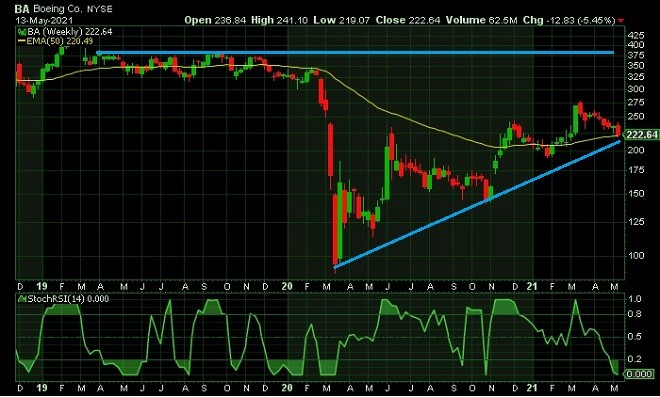
The historical price chart indicates that the stock moves along the ascending trend line, as shown in the image below. The next resistance is anticipated only between 300 and 375.
Additionally, the stock is trading above its 50-day moving average, while the stochastics RSI indicator is in the oversold region. Therefore, we are anticipating the stock to rally in the days ahead.
Disclaimer: Any financial trading analysis offered here is our opinion and is not intended as advice or direction for investors. We cannot guarantee the success of any trades made as a consequence of this article, and we encourage traders to incorporate a strong money management strategy to limit losses when they enter the markets. Please use this article as part of your own research before formulating strategies prior to trading.