Life science company Bayer AG (OTC: BAYZF, XTR: BAYN) revealed that it is acquiring Asklepios BioPharmaceutical Inc, also referred to as AskBio, in a deal worth up to $4 billion to build up the drug manufacturing division as it is under pressure after the takeover of seed behemoth Monsanto. The stock of Bayer closed almost flat at $49.95.
Under the takeover agreement, Bayer will pay $2 billion immediately and up to $2 billion based on the achievement of certain milestones. The US-based AskBio is developing a path-breaking gene therapy, which involves the insertion of a functional gene to nullify the impact of a disease triggered by a nonexistent or defective gene.
Richard Jude Samulski, the co-founder of AskBio, spearheaded the employment of adeno-linked viruses as transporters to substitute a faulty gene with a healthy one. In 2016, Pfizer Inc acquired Bamboo Therapeutics Inc. from AskBio, as Pfizer looked for ways to increase its presence in the medicament of rare diseases.
Currently, the North Carolina-based AskBio is involved in the early-stage development of therapies for treating diseases such as Pompe, Parkinson’s, and congestive heart failure.
The previous largest acquisition in the pharmaceutical arena by Germany-based Bayer was in 2006 when it took over domestic competitor Schering AG. The inventor of aspirin has been facing several legal battles since the takeover of the US firm Monsanto in 2018.
The takeover of Monsanto in a $63 billion deal was intended to give a huge push to its pharmaceutical revenues. On the contrary, it burdened Bayer with prolonged legal warfare over whether Monsanto’s Roundup weed killers can trigger cancer, a battle that has knocked Bayer’s market cap. Bayer continues to insist that Roundup does not cause any harm.
However, last month, Bayer warned investors that the COVID-19 pandemic would impact its agriculture business in a more challenging manner than anticipated. Bayer is also facing drawbacks in closing the Roundup-related lawsuits that demand roughly $10.90 billion as compensation.
The earnings caution has made it difficult for Bayer to justify the acquisition of Monsanto and its capability to increase Bayer’s bottom line.
In the meanwhile, Bayer’s drug pipeline has been of great concern to investors. The company’s blockbuster drugs, blood thinner Xarelto and eye treatment Eylea, will lose patent protection beginning around 2024.
Analysts are worried that Bayer lacks encouraging products in its R&D lineup to offset the decline in sales due to a loss of patents related to blockbusters. To improve its lineup of products, Bayer has been scouting for partnerships related to drug development or licensing of drugs in the final stages of clinical advancement.
Stefan Oelrich, CEO of Bayer’s pharmaceuticals, revealed that at the first instance, he felt AskBio was a bit bigger than what the company was looking for in the pharmaceutical domain, but following a telephonic conversation with the founders of AskBio, he was convinced that it would be a “perfect fit.”
Oelrich said, “What we now have is a comprehensive pipeline. I feel like things are really coming together on the pharma side.”
Oelrich opined that it was premature to forecast revenue that is likely to be generated by AskBio. Nevertheless, he anticipates the agreement to assist Bayer in transforming into a leader in gene therapy, which is again gaining momentum after a serious setback in the 1990s, when numerous patients died.
More than a dozen gene therapies are currently undergoing clinical trials, and major pharmaceutical firms have been taking over gene-therapy companies, with expectations of a path-breaking success of those therapies in the years ahead.
The takeover news is expected to turn the stock slightly bullish in the days ahead.
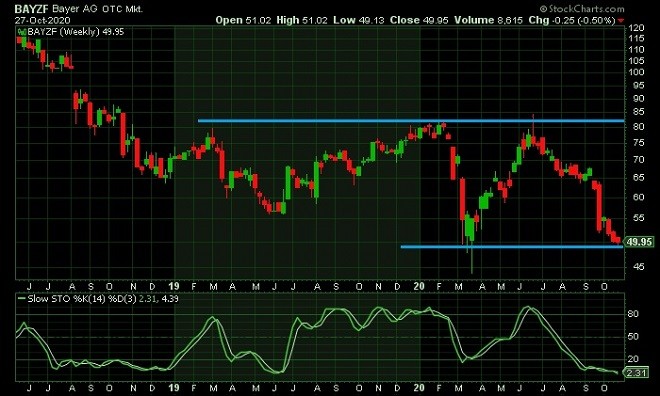
The price chart of Bayer indicates solid support at 50. The next resistance is anticipated only near 80. Furthermore, the stochastic oscillator is also in the oversold region. Therefore, we are anticipating the stock to begin a fresh uptrend in the next few days.
Disclaimer: Any financial trading analysis offered here is our opinion and is not intended as advice or direction for investors. We cannot guarantee the success of any trades made as a consequence of this article, and we encourage traders to incorporate a strong money management strategy to limit losses when they enter the markets. Please use this article as part of your own research before formulating strategies prior to trading.