In the past year, the price of platinum has decreased by approximately $450 to reach a low of $811 per ounce in January 2016. As of date, the price has recovered marginally to hit a high of $980 per ounce on Monday. In fact, platinum, which is widely used in both the jewelry and automobile industry, continues to trade below the price of gold, a rare event that has happened only four times in the past four decades.
The platinum market remains oversupplied from the South African miners. This has greatly contributed to the decline in the price. The market saw a deficit of 700,000 ounces in 2015. However, the liquid stockpile above the ground is enough to balance the deficit for the next year.
The recent production data reflected a decline in output growth. However, the price is expected to bounce back strongly only when the high-cost mines shut down their operations permanently.
Furthermore, the broader sell-off seen in the commodity sector continues to have a negative impact on the price of platinum. The emission scandal of Volkswagen only added to the intensity of sell-off as the demand for platinum, which is used in the auto-catalysts of diesel engines, was expected to decline along with a drop in the demand for diesel cars. Stricter emission norms also threaten the demand for platinum.
The economic slowdown in China has also affected the demand for platinum (Jewelry) in a considerable manner and the analysts at Bank of America Merrill Lynch do not expect a change in the scenario anytime soon. Surprisingly, the decline of the equity market has not contributed much to the appreciation of platinum this time. The primary reason for such an anomaly is the strength of the US dollar.
Investors now mitigate the risk by investing in multiple safe-haven assets such as the US treasuries, gold, Japanese Yen, and the Swiss Franc. Such a scenario has considerably decreased the probability of a steep rise in the price of platinum. The commodity market is also gripped by the fear of another Fed rate hike, which would trigger another round of price decline in precious metals.
Finally, the impact of quantitative easing measures is beginning to reflect in the US economic data. The ISM manufacturing PMI (purchasing managers’ index) reading of 49.5 announced last week was better than the analysts’ estimate of 48.5. The construction spending data hit an eight-year high. Of late, the positive economic data have revived investors’ interest in the stock market, thereby resulting in stagnation of the price of precious metals. Thus, fundamentally, platinum is expected to remain range-bound with bearish bias in the short-term.
Technically, as shown in the image below, platinum faces heavy resistance at $1022 per ounce. Major support exists at 886 levels.
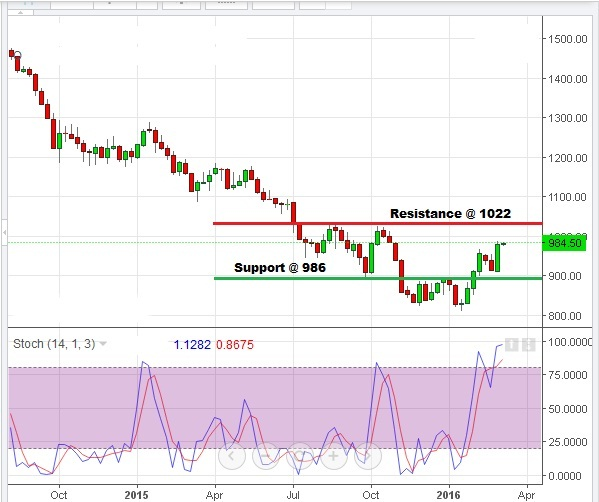
The stochastic reading of about 95 reflects an overbought situation. Thus, a binary options trader should purchase a put option contract with March-end expiry. The suggested strike price for the put option contract is $900.
Disclaimer: Any financial trading analysis offered here is our opinion and is not intended as advice or direction for investors. We cannot guarantee the success of any trades made as a consequence of this article, and we encourage traders to incorporate a strong money management strategy to limit losses when they enter the markets. Please use this article as part of your own research before formulating strategies prior to trading.