
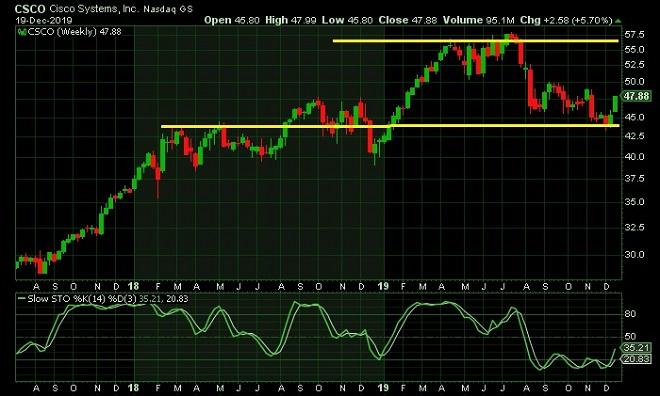
Shares of Cisco Systems Inc. (Nasdaq: CSCO) rose $1.24 or 2.66% to close at $47.88 after Tim Long, an analyst at Barclays upwardly revised the stock to “overweight” from “equal weight” on the basis of numerous product cycles that are forthcoming in routing, switching, and WLAN offerings. The shares of Cisco have appreciated 7.64% in the year-to-date, but have dropped over 5% in the last three months.
The analyst highlights the increasing growth rate of the San Jose, California-based company’s security and applications business, in addition to the company’s aggressive stance of purchasing assets to assist in the business division’s growth.
Long stated that he is optimistic, based on the latest product offerings. In his report to clients, Long wrote: “We are more constructive on CSCO shares following the lowered valuation and new product announcements, We see some fundamental shifts, and the stock has typically done well after guidance corrections.”
Based on the above argument, the analyst upwardly revised the networking-equipment company’s share price target to $53 from $47. Analysts surveyed by Bloomberg have given an average price target of $51.48. Nineteen analysts have given a “buy” rating while two analysts have given a “sell” rating for the stock.
Last month, Cisco Systems reported better-than-anticipated 1Q 2020 earnings but pointed out that unpredictable situations would affect orders from clients in the upcoming months.
For the quarter ended September, Cisco posted earnings of $0.84 per share, almost $0.04 per share above the Wall Street consensus estimates. Revenue increased 1% y-o-y to $13.32 billion, surpassing analysts’ forecasts of $13.08 billion.
The company, nevertheless, issued a weak 2Q 2020 outlook that failed to meet Wall Street’s view, with earnings forecast in the range of between $0.75 per share and $0.77 per share on revenues in the range of $11.80 billion to $12.10 billion.
Orders also fell due to “a challenging macro environment,” according to CEO Chuck Robbins.
Jim Cramer and the Action Alerts PLUS team, which have invested in Cisco, highlighted the downward revision of 2Q 2020 earnings forecast. They said, “All in, the quarter looked fine against previously muted expectations, however, management had to lower numbers for the second quarter in a row.”
The AAP team also pointed out the positive developments related to the company’s product offerings. “Even so, there are still positives to point out, such as how well products like the Catalyst 9000 with the campus switching cycle are selling, as well as security services. But what Cisco can hang its hat on is the portfolio transformation story.”
In the last few months, Cisco has been introducing new products related to IoT (Internet of Things).
The most important chip in the product lineup is Cisco Silicon 1, built by Leaba Semiconductor, an Israel based company taken over by Cisco three years ago. The chip, designed to be the heart of an optical router, can transfer 10.8 terabytes of data per second. The optical router can link to a new standard named OpenRoaming, which can log gadgets to Wi-Fi 6 facilities in a mechanical manner. The company is also reworking its tracking software.
The sixth acquisition of Cisco this year is low-latency router manufacturer Exablaze, which is gaining prominence in stock trading and other specialized financial applications. The positive developments related to operations and upward revision by Barclays is expected to keep the shares of Cisco bullish in the short-term.
Technically, the stock is having firm support at 43. The next major resistance is at 56. Additionally, the stochastic oscillator has started rising after coming out of the oversold zone. Therefore, we are anticipating the stock to move up in the short-term.
Disclaimer: Any financial trading analysis offered here is our opinion and is not intended as advice or direction for investors. We cannot guarantee the success of any trades made as a consequence of this article, and we encourage traders to incorporate a strong money management strategy to limit losses when they enter the markets. Please use this article as part of your own research before formulating strategies prior to trading.