Last week, the stimulus measures announced by the BoE (Bank of England) triggered a selloff in the Pound. While the 25 basis point rate cut was not a surprise, the substantial expansion in the monetary easing program was certainly unexpected by the market. On the other hand, the overwhelmingly positive US non-farm employment change data indicates that the Greenback would remain bullish in the short-term.
There are further factors, as discussed in detail below, which indicate that the GBPUSD pair will decline further from the current level of about 1.3100.
Last year, the UK recorded a current account deficit of 5.4%, the largest among G7 economies. This situation has only worsened in the first quarter of 2016. At the end of March, the fiscal deficit stood at 6.9% (about £32.6 billion) of the UK’s GDP. The rise in the deficit continues to put pressure on the Sterling Pound as investors seek greener pasture elsewhere.
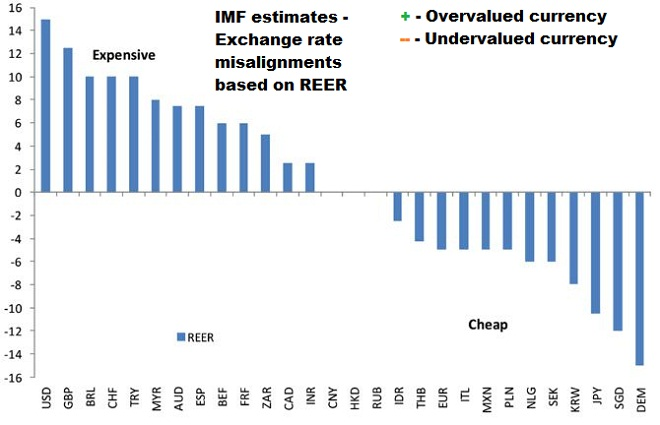
The REEL (Real Effective Exchange Rate) of the UK, calculated by dividing the nominal exchange rate by index of costs or price deflator, reflects whether a currency is in an overvalued or undervalued state. An overvalued currency would prove detrimental to exports and pull down economic growth. In this regard, the IMF and Deutsche bank chart provided below indicates that the Pound is the most expensive currency next only to the US dollar.
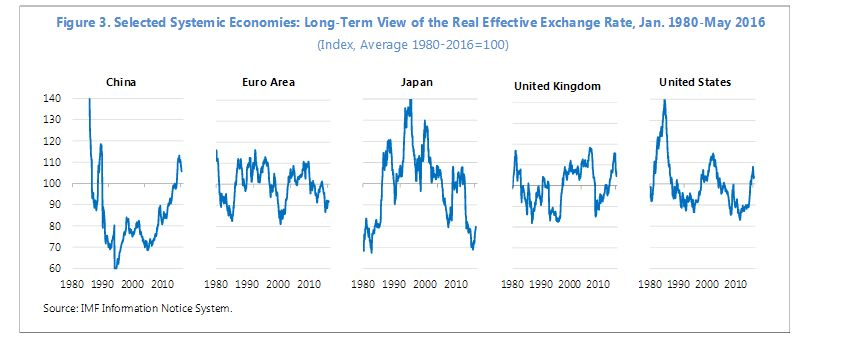
As shown below, the exchange rate of the Pound is also higher than the long-term average. This means that there exists enough space for the exchange rate of the Pound to decline further.
The BoE announced a rate cut of 25 basis points last week. As mentioned earlier in this article, it was not a surprise at all. However, the £60 billion expansion of the quantitative easing program was an unexpected move, which is expected to keep the Pound under selling pressure. The benchmark rate currently stands at 0.25%.
The futures data released by the CFTC indicate that the speculators are adding up short positions in the Pound. This indicates that the market has a bearish view of the Pound.
In the US, the economic data announced on Friday was largely positive. In particular, the non-farm employment change data surpassed the analysts’ expectations by a wide margin. In July, 255,000 jobs were added against the market’s expectation of 180,000. The positive economic data is expected to keep the US dollar strong.
After failing three attempts to cross above 1.3270, the GBPUSD is on a downtrend as revealed by the descending channel. The momentum has turned negative as well. The next support for the pair exists only at 1.2900.

A short position in the GBPUSD pair, near 1.3100 levels, is the most suited trade in the prevailing circumstances. A stop-loss order can be placed at 1.3200, while the order to book profit can be placed at about 1.2900.
Based on the fundamental and technical analysis, we believe that a binary options trader should certainly contemplate the purchase of a one-touch put option contract. A strike price of not less than 1.2920 should be chosen for the trade. Since the analysis was done on an H4 time frame, we believe that a two-week time period would be more than enough for the exchange rate to pierce through the forecasted level.
Disclaimer: Any financial trading analysis offered here is our opinion and is not intended as advice or direction for investors. We cannot guarantee the success of any trades made as a consequence of this article, and we encourage traders to incorporate a strong money management strategy to limit losses when they enter the markets. Please use this article as part of your own research before formulating strategies prior to trading.