

Mixed macro data from across the eurozone turned the euro-dollar weak early yesterday. However, the EUR/USD currency pair moved up in the mid-European session as risk appetite improved before turning lower in the American session. Higher than anticipated unemployment claims and weak pending home sales data from the US turned the greenback weak.
Improved market sentiment and weak US data aid the Euro
The EURUSD pair headed lower shortly after the release of the French Q3 GDP data by statistical body Insee. While the Q3 GDP growth figures remained unchanged at 0.4% on a q-o-q basis, the annualized GDP growth rate of 1.4% missed expectations by 0.1%.
The EURUSD pair extended its losses despite the report of the upbeat German unemployment change data, which indicates an unemployment rate of just 5% in October. It is the lowest level since the unification of Germany. The number of unemployed people fell by 16,000, versus economists’ anticipation of a decline by 10,000.
Notably, in November, around 807,000 vacancies were reported to the Federal Labour Agency (BA), an increase of 35,000 from last year. However, the weak German CPI data released by the Federal Statistical Office triggered another decline in the EURUSD pair.
The German Statistical organization Destatis stated that compared to October, the CPI edged up 0.1% in November. Economists had anticipated 0.2% price growth. On an annualized basis, the consumer price index increased 2.3% y-o-y following a 2.5% gain in October, which was the highest recorded inflation in over a decade. Economists had anticipated 2.4% inflation for November. In September, inflation was 2.3%. The statistical office is scheduled to report the final results for November on December 13.
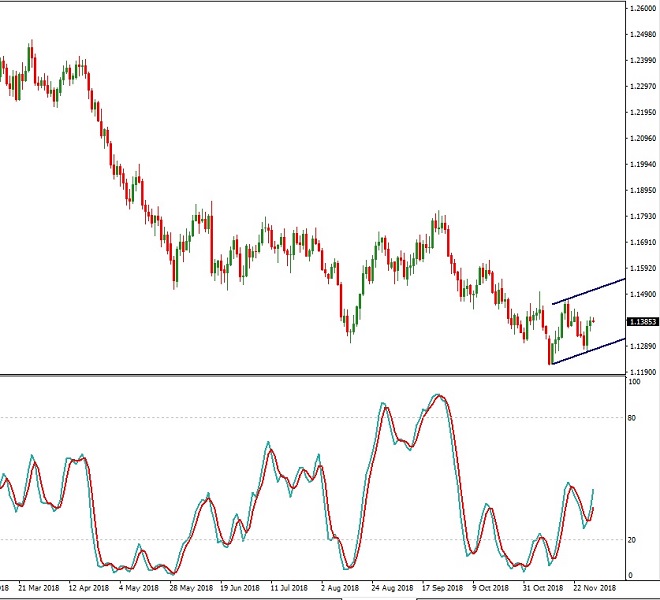
Following the CPI data, the EURUSD pair declined to 1.1350 levels. However, the higher-than-anticipated unemployment claims and weak pending home sales reported by the US organizations reverse trend later yesterday.
The number of Americans who applied for unemployment benefits in Thanksgiving week hit the highest level in six months. Initial jobless claims, a loose way to guess layoffs, increased by 10,000 to 234,000 in the week ended November 24, based on seasonally adjusted government figures. To the market’s surprise, it was the third successive increase and easily surpassed the 220,000 forecast of economists. The number of people already receiving unemployment benefits rose by 50,000 to 1.7 million.
Pending home sales fell in October, as higher mortgage rates have made it challenging to purchase a home and have discouraged potential buyers. The National Association of Realtors has stated that the pending home sales index declined 2.6% last month to 102.1. On the basis of contract signings, the index has tumbled 6.7% from a year ago.
After nine years of robust growth, the US economy seems to be slowing down. It is not growing as fast as it did in the spring and summer. The weak economic data is expected to keep the US dollar on a decline.
The historical price chart indicates that the EURUSD pair has received support at 1.1290 levels. Furthermore, the stochastic indicator is also moving towards the bullish zone. As a result, we can expect the EURUSD pair to move up in the short-term.
Disclaimer: Any financial trading analysis offered here is our opinion and is not intended as advice or direction for investors. We cannot guarantee the success of any trades made as a consequence of this article, and we encourage traders to incorporate a strong money management strategy to limit losses when they enter the markets. Please use this article as part of your own research before formulating strategies prior to trading.


