
The anticipation of a rate hike on Thursday is keeping the Pound strong against the currencies of developed economies. On the other hand, the fourth consecutive decline in the price of dairy products and the rise in energy prices keep the Kiwi dollar weak. However, we expect the Pound to decline against the Kiwi dollar in the week ahead due to the reasons given below.
The Bank of England is expected to hike interest rates during the monetary policy meeting scheduled to be held on Thursday. The central bank is widely expected to raise interest rates by 25 basis points to 0.75%, from the present level of 0.5%. However, the rate hike is not expected to boost the Pound as the announcement will not provide any kind of surprise to the market.
The Bank of England also reported a 0.3% decline in the M4 money supply, or broad money, in June, compared with a 0.4% increase in the previous month. Economists had expected the broad money to increase by 0.6% in June. In the early economic cycle, an increase in broad money results in a rise in spending and investment. Therefore, a decrease in broad money is expected to weaken the Pound by bringing down spending and investment.
The New Zealand dollar has begun the week strongly after inflation inched higher during the second quarter of 2018, pushing the annual consumer price index to 1.5%, which is in line with economists’ expectations. After declining by 0.5% in the first quarter, inflation rose by 0.4% in the second quarter, but missed analysts’ estimates by 0.1%. Still, the rise in the annual consumer price inflation has turned the kiwi dollar stronger.
The Kiwi dollar is also expected to get a boost later today when Statistics New Zealand reports second-quarter labor market data. The Labor-led coalition government has implemented an increase in the minimum wage to $16.50 per hour, from $15.75 per hour in April 2018. Furthermore, the minimum wage is set to rise from $15.75 per hour to $20 per hour in 2020. Obviously, the improved wages is expected to have a positive impact on the labor-cost index.
The Reserve Bank of New Zealand has kept the interest rate unchanged at a record low of 1.75% for the past two years, citing weak wages and below-target inflation. The wage increase implemented by the government is expected to increase consumer spending and inflation. Therefore, the wage hike has also increased the prospects of a rate hike. All these factors are expected to turn the Kiwi dollar bullish against the Pound in the short-term.
The GBPNZD pair is moving along a descending channel as shown in the historical price chart below. The currency cross has also broken the 50-day moving average. Furthermore, the momentum is weakening as indicated by the lower high formations. Therefore, we are anticipating the GBPNZD pair to move down in the days ahead.
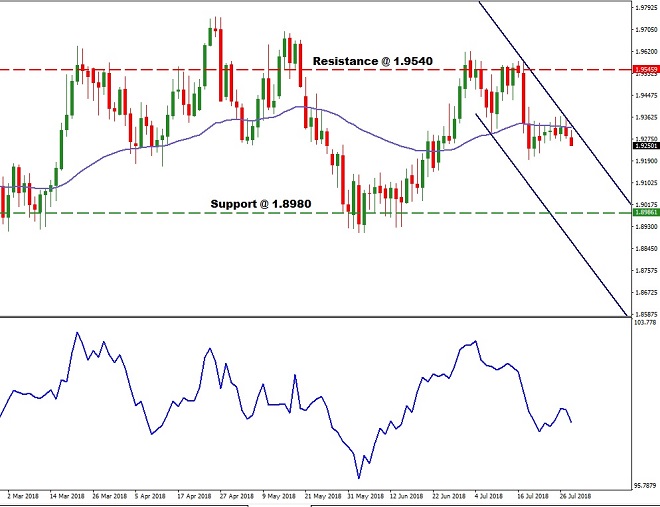
We are planning to set up two trades, one each in the Forex and binary market. In the Forex market, we may go short in the GBPNZD pair near 1.9250, with an aim to book profit near 1.8980. To minimize risk, we would place a stop-loss order above 1.9360.
Simultaneously, using our binary options trading account, we are planning to invest in a put option, which remains active for a period of one week. The option may be bought only if the GBPNZD pair trades near 1.9250.
Disclaimer: Any financial trading analysis offered here is our opinion and is not intended as advice or direction for investors. We cannot guarantee the success of any trades made as a consequence of this article, and we encourage traders to incorporate a strong money management strategy to limit losses when they enter the markets. Please use this article as part of your own research before formulating strategies prior to trading.


