The US dollar weakened against the greenback on Friday after a series of economic data came in below market expectations. Additionally, President Donald Trump voiced his concerns over the possible impact of a strong dollar on the economy on Saturday. This has given currency market participants another opportunity to push the greenback down against its peers, including the euro. From a low of 1.1345, the EUR/USD pair rose to a high of 1.1405 before closing at 1.1370 on Friday.
Decline in personal income, ISM mfg. PMI & UoM consumer sentiment weakens the US dollar
US personal income declined in January, the first of its kind in three years, and consumer spending fell to its lowest level since December 2009, placing the US economy on a slow growth path in the first quarter of 2019.
The Commerce Department said personal income declined 0.1% in January, the first drop since November 2015, after rising 1.0% in December. Analysts anticipated a 0.3% increase in personal income on a m-o-m basis. Income declined mainly due to decreases in dividend and interest income.
Similarly, personal spending declined 0.5% m-o-m in January, compared with the 0.6% increase in December. Economists anticipated personal expenditures to decrease by 0.3% in the reported month.
The economic outlook also turned gloomy as data related to factory activity fell below the two-year low in February, with manufacturers confirming a slowdown in both hiring and new orders.
Eric Winograd, a senior US economist at AllianceBernstein in New York, said “A modest slowdown remains the most likely path for 2019. We shouldn’t expect any action from the Fed into at least the second half of the year.”
In other economic data released by the Institute for Supply Management, manufacturing PMI declined to 54.2 in February, from 56.6 in March. The reported figures also missed analysts’ estimates of 55.6.
Later that day, the University of Michigan reported a decline in the final consumer sentiment reading to 93.8 in February, from 95.5 detailed earlier. Economists had anticipated a reading of 95.8.
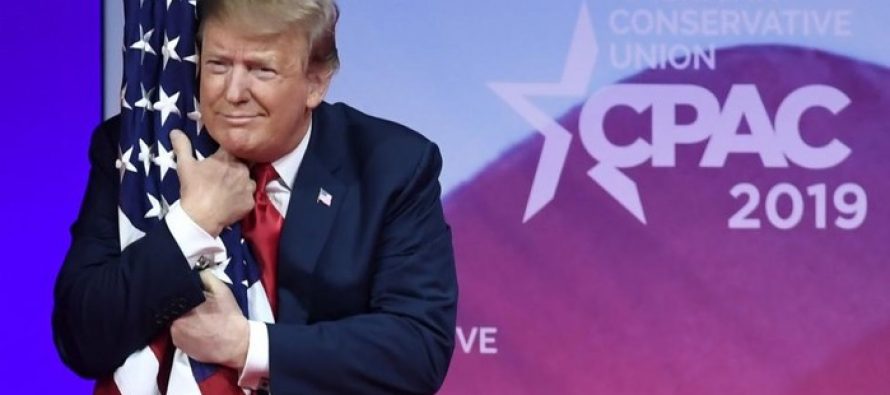
On Saturday, during his nearly two-hour speech at the Conservative Political Action Conference, Trump once again criticized the frequent interest rate hikes by the Federal Reserve. Trump believes that monetary policy tightening would further lead to the strengthening of the US dollar and the slowdown of the US economy.
Trump said “America is now booming like never before. Other countries are doing very poorly. That makes it even harder for us to be successful. Plus, we have a gentleman that likes raising interest rates in the Fed.”
Regarding the US-China trade talks, there have been reports that both parties are nearing an amicable agreement. On tariffs, Trump pointed to near 40% increase in import duty on US goods by China over the past few years, Trump said “How is it possible you got away with this for so long? Because nobody asked us to change. We should have been doing the same thing to them, but we didn’t. It’s hard to believe.”
Notably, Saturday marks the end of a year since Trump popularly said: “trade wars are good and easy to win.”
The series of weak economic data and Trump’s rhetoric against interest rate hikes are expected to keep the US dollar weak in the days to come.
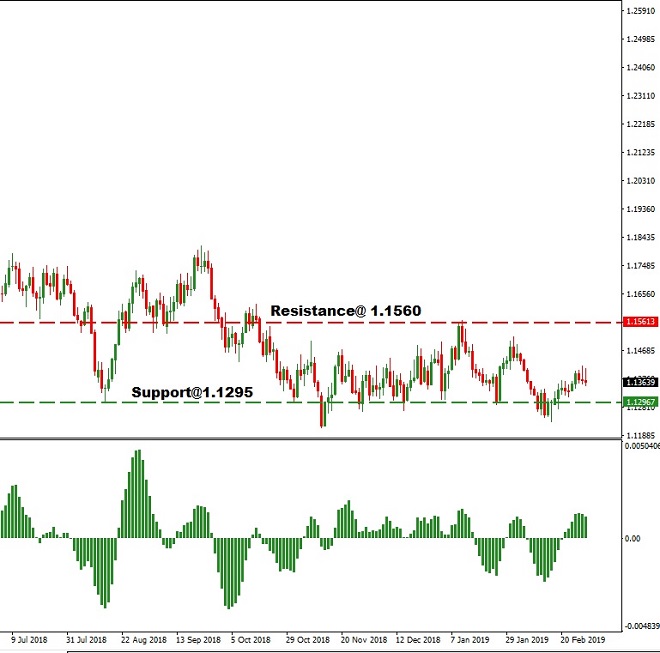
Technically, the EUR/USD pair remains range-bound between 1.1295 and 1.1560. The currency pair bounced off the support last week. The oscillator of the moving average is also in the positive region. As a result, we can expect the currency pair to move upwards and hit the upper band.
Disclaimer: Any financial trading analysis offered here is our opinion and is not intended as advice or direction for investors. We cannot guarantee the success of any trades made as a consequence of this article, and we encourage traders to incorporate a strong money management strategy to limit losses when they enter the markets. Please use this article as part of your own research before formulating strategies prior to trading.