
Video Source: CNBC Television on YouTube
The Aussie remained weak against the greenback yesterday following the release of lower-than-anticipated trade surplus data for July. In the US session, the Bureau of Labor Statistics reported seven months of low unemployment claims. This enabled the US dollar to consolidate its position. Overall, the AUD/USD pair traded between 0.6362 and 0.6395 in the past 24 hours.
According to the Australian Bureau of Statistics, the country’s trade surplus declined to A$8.04 billion in July from A$10.27 billion in June and missed forecasts of A$10.05 billion. The reported figure was the smallest trade surplus since February 2022, as exports contracted while imports increased.
Goods and services exports fell by 2% m-o-m (or A$1.096 billion) in July to a 16-month low of A$53.92 billion. The decline was primarily due to a drop in shipments to China, which is Australia’s numero uno trading partner. In the meantime, goods and services imports rose by 2.5% (or A$1.13 billion) to A$45.88 billion, primarily led by non-industrial transport machinery.
According to the US Department of Labor, the country’s unemployment claims fell to 216,000 in the week ended September 2 from 229,000 (upwardly revised by 1,000) in the earlier week. Economists had anticipated an increase in jobless claims to 232,000.
The four-week moving average was 229,250, a decrease from 237,750 (upwardly amended by 250) in the previous week’s average.
According to the Bureau of Labor Statistics, US nonfarm business productivity inched down by 3.50% q-o-q in the second quarter, following a decline of 1.20% in the previous quarter. The preliminary estimates pegged the nonfarm productivity growth at 3.50%. Economists had anticipated no change in nonfarm productivity.
Output grew by 1.9%, falling short of the preliminary estimate of 2.4%, while hours worked were down by 1.5%, slightly steeper than the preliminary estimate of a 1.3% drop. Every year, productivity rose by 1.3%, marking the first increase since the fourth quarter of 2021.
Output rose by 1.90%, missing the preliminary estimate of 2.40%. Hours worked declined by 1.50%, slightly higher than the preliminary estimate calling for a 1.30% decrease. On a y-o-y basis, productivity increased by 1.30%, reflecting the first rise since 4Q 2021.
The Bureau of Labor Statistics also stated that US unit labor costs in the nonfarm business sector rose by 2.20% q-o-q in the June 2023 quarter, following a 1.60% rise in the previous quarter and greater than forecasts of a 1.80% increase.
The increase reflects a 5.70% rise in hourly compensation and a 3.50% growth in productivity. Overall, unit labor costs rose by 2.50% over the past four quarters.
The weak Australian economic data is expected to keep the AUD/USD pair range-bound in the short term.
The historical price chart indicates that the AUD/USD pair is declining after facing resistance at 0.6610. The next support is anticipated only near 0.6280. Additionally, the stochastic indicator is in the bearish zone, while the currency pair is trading below its 50-day moving average. Therefore, we anticipate the currency pair to remain in a downtrend in the short term.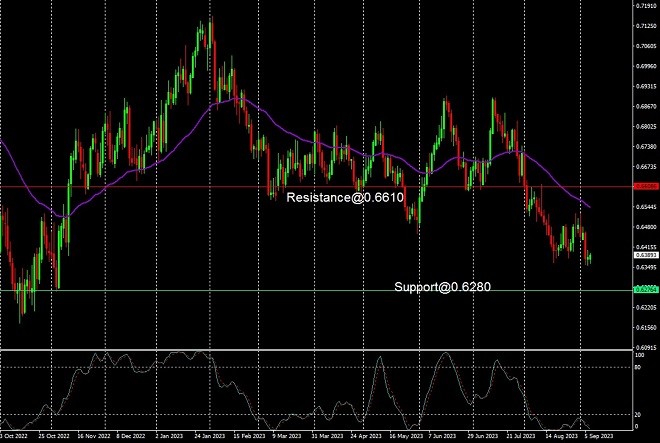
Disclaimer: Any financial trading analysis offered here is our opinion and is not intended as advice or direction for investors. We cannot guarantee the success of any trades made as a consequence of this article, and we encourage traders to incorporate a strong money management strategy to limit losses when they enter the markets. Please use this article as part of your own research before formulating strategies prior to trading.