
The euro fell against the US dollar yesterday following reports of a contraction of the German manufacturing sector in August. Later the day, the euro’s decline was fueled by lower than anticipated US jobless claims and better than anticipated manufacturing PMI data. The EUR/USD currency pair dropped from a high of 1.0048 to a low of 0.9972 in the last 24 hours.
As per to Destatis, German retail sales grew by 1.90% m-o-m in July, following a decline of 1.60% in the previous month. Economists had anticipated a 0.10% drop in retail sales for the reported period.
On an m-o-m basis, the country’s retail sales contracted 2.60% in July.
The S&P Global / BME German final manufacturing Purchasing Managers’ Index (PMI) inched lower to 49.1 in August, from 49.30 in July. The reported reading was lower than preliminary estimates of 49.80. Economists did not anticipate any change in the preliminary estimates. A reading below 50 indicates contraction, and vice versa. The reported reading reflects the second successive month’s decline following two years of expansion. Subsequently, German manufacturers reported a decline in backlogs for the third consecutive month.
The S&P Global Eurozone final manufacturing PMI inched down to a 26-month low of 49.6 in August, from 49.8 in July, and a notch lower than the preliminary estimate of 49.70. Economists’ did not anticipate any change in the preliminary reading.
The reported reading was the lowest since June 2020 and indicated a second consecutive contraction in the manufacturing sector. Overall, the Eurozone manufacturing output index improved to a two-month high of 46.50 in August, from 46.30 in July.
Notably, manufacturing inventory levels increased in August due to a slowdown in incoming fresh orders. According to Eurostat, the Eurozone unemployment rate fell to 6.60% in July, from 6.70% in June, and met the market’s expectations. In July 2021, the Eurozone unemployment rate stood at 7.70%.
According to the US Department of Labor, the country’s first-time unemployment claims were 232,000 in the week ended August 27, compared with 237,000 (downwardly amended from 243,000) in the prior week. The reported figure exceeded market expectations for jobless claims of 250,000.
The four-week moving average was 241,500, down from 245,500 (downwardly revised from 247,000) in the earlier week.
According to the Institute for Supply Management, the US manufacturing PMI (purchasing managers index) stood at 52.80 in August, unaltered from July. Economists had anticipated the index to inch lower to 52.10. The reported figure indicates an overall expansion of the economy for the 27th successive month, following a contraction in April and May 2020. For a second consecutive month, the manufacturing PMI stood at the lowest level since June 2020, when the reading was 52.40.
The fresh orders index was 51.30 in August, up from 48 in July. The production index reading fell by 3.1 points to 50.40 in August.
Also, the backlog of orders index grew by 1.7 points to 53. Following three consecutive months of contraction, the employment index entered expansion territory, with the corresponding reading rising to 54.20 in August from 49.90 in July.
The upbeat unemployment data is expected to keep the EUR/USD pair slightly bearish in the short term.
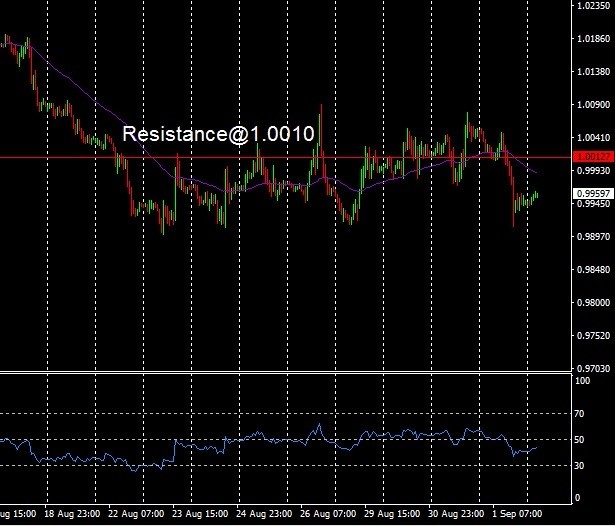
The historical price chart reveals that the EUR/USD currency pair is on a downtrend after facing resistance at 1.0010. The following support is anticipated only near 0.9590. Also, the pair is trading below its 50-day moving average while the RSI indicator is showing a reading below 50. Therefore, we anticipate the pair to stay in a downtrend in the days ahead.
Disclaimer: Any financial trading analysis offered here is our opinion and is not intended as advice or direction for investors. We cannot guarantee the success of any trades made as a consequence of this article, and we encourage traders to incorporate a strong money management strategy to limit losses when they enter the markets. Please use this article as part of your own research before formulating strategies prior to trading.