
The EUR/USD pair rallied yesterday despite the release of weaker than anticipated Eurozone industrial production data. In the US session, the PPI data published by the Bureau of Economic Analysis was better than forecasts made by economists.
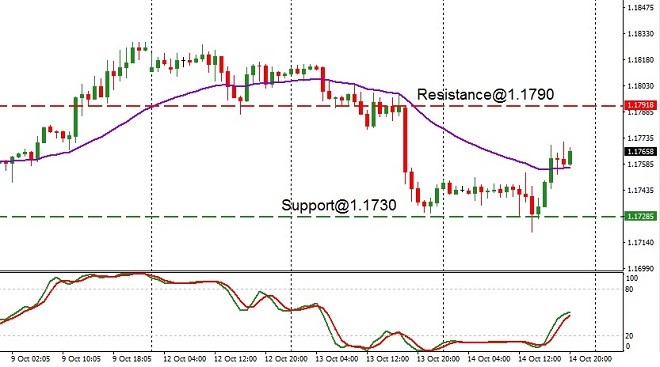
Still, the US dollar tumbled against the euro dollar as the market was concerned about the lack of agreement in negotiations related to the US stimulus program. In the past 24 hours, the EUR/USD pair rallied from a low of 1.1719 to a high of 1.1770.
According to the European statistical organization Eurostat, the Eurozone industrial production increased 0.7% m-o-m in August, following a growth of 5% in the earlier month. Economists had anticipated industrial production to grow by 0.8%. On a y-o-y basis, industrial production declined 7.2% in August 2020.
Furthermore, on a monthly basis, the growth in industrial production was led by a 6.8% increase in durable consumer goods, a 3.1% rise in intermediate goods, and a 2.3% growth in the energy sector. However, the production of both capital and non-durable consumer goods decreased by 1.6%.
On a yearly basis, the production of capital goods declined by 13.2%, while intermediate goods recorded a negative 5.4% growth. Non-durable consumer goods and energy sector posted -3.9% and -3.6% expansion, respectively. However, durable consumer goods recorded a 4.3% growth.
In the US, according to the Bureau of Labor Statistics, producer price index (PPI) increased 0.4% m-o-m in September, following an increase of 0.3% in the earlier month. It is the third increase in a row. The reported figures also surpassed economists’ expectations of a 0.2% increase.
On a y-o-y basis, the PPI rose 0.4% in September 2020, reflecting the first increase after rising 0.3% y-o-y in March. In September, about 2/3rds of the increase in PPI was driven by a 0.4% rise in the index for final demand services. Similarly, prices for final demand goods also grew by 0.4%.
Barring volatile goods (food, energy, and trade services), core PPI increased 0.4% m-o-m in September, following an increase of 0.4% in the earlier month and greater than the 0.2% growth anticipated by economists. It is the largest recorded growth since April 2019.
For the year ended September 2020, core PPI increased 0.7%, mirroring the highest rise since advancing 1% y-o-y in March 2020.
With a growth of 0.5 in September, final demand services contributed over 80% of the PPI increase. A 3.9% rise in the index for traveler accommodation services was also a key factor in the PPI rise in September.
For the fifth successive time, the index for final demand goods rose 0.4% in September. The increase was led by a 14.7% increase in the price of iron and steel scrap.
As the market is presently concerned about the stalemate in stimulus discussions, the greenback remains weak. Therefore, we can expect the EUR/USD pair to be range-bound with a slight bullish bias.
Technically, the EUR/USD pair is ascending after testing the support at 1.1730. The next minor resistance is anticipated only near 1.1790. The currency pair is trading above its 50-day moving average. Additionally, the stochastic oscillator is also rising. Therefore, we are expecting the EUR/USD pair to rally further in the near-term.
Disclaimer: Any financial trading analysis offered here is our opinion and is not intended as advice or direction for investors. We cannot guarantee the success of any trades made as a consequence of this article, and we encourage traders to incorporate a strong money management strategy to limit losses when they enter the markets. Please use this article as part of your own research before formulating strategies prior to trading.