
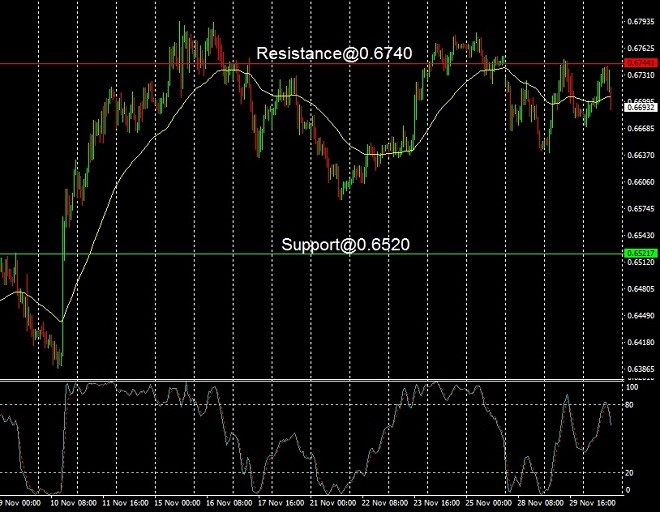
The Aussie remained range bound against the greenback yesterday following the release of weak economic data from both the US and Australia. While the Australian consumer price inflation and building approvals data for October missed estimates, the US non-farm employment, goods trade deficit, and prelim wholesale inventories data missed estimates. Overall, the AUD/USD pair traded between 0.6680 and 0.6740 in the past 24 hours.
The Australian Bureau of Statistics stated that consumer price inflation rose by 6.90% y-o-y in October, following a 7.30% rise in the prior month but missing forecasts of a 7.60% increase against the backdrop of a slower pace of increase in food prices.
Specifically, food and non-alcoholic beverages recorded an increase of 8.90% in October, compared with a 9.60% rise in the prior month. In the meantime, the cost of housing grew by 10.50% in October, following a surge of 10.30% in the earlier month. Rent prices increased by 3.50% in October, from 2.90% in the prior month. Transport grew by 7.40%, compared with 6.80%.
On a m-o-m basis, excluding volatile items such as fruit, vegetables, and fuel, the consumer price index increased by 6.40% in October, from 6.80% in September. Overall, the inflationary pressure stood far higher than the RBA’s target range of 2% to 3%.
As per data published by the ABS, the country’s building approvals declined 6% m-o-m in October, following a drop of 8.10% in the prior month, and worse than forecasts of a 2% decrease.
Private sector hour approvals fell by 2.20% in October, following an 8.40% drop in September. Likewise, private sector dwellings, excluding houses, approved dropped by 11.30% in October, following a 6.90% fall in September. While the value of non-residential buildings rose by 2.60%, the value of total buildings inched down by 0.20%.
According to the data published by Automatic Data Processing, the US non-farm payrolls increased by 127,000 in November, following the addition of 239,000 jobs in the prior month but missing forecasts of 196,000 job additions. The reported figure is the lowest since January 2021.
While the goods-producing sector lost 86,000 jobs, service-providing jobs added 213,000 jobs. Under the goods-producing sector, the manufacturing industry lost 100,000 jobs. Under the service-providing sector, the leisure/hospitality industry added 224,000 jobs.
According to the second estimate provided by the Bureau of Economic Analysis, the US economy expanded 2.90% q-o-q in the September 2022 quarter, following a contraction of 0.60% in the June 2022 quarter. The advance estimate pegged US Q3 GDP growth at 2.60%. Economists had anticipated the economy to expand by 2.80%.
On an annual basis, the US GDP grew by 7.30% (or $450.50 billion) to $25.70 trillion, upwardly revised by $35.70 billion from the earlier estimate.
The price index for gross domestic purchases rose by 4.70% in 3Q 2022, up 0.10% from the earlier estimate. Likewise, the PCE price index grew by 4.30%, upwardly revised by 0.10% from the prior estimate.
The data published by the US Census Bureau indicated that the country’s trade deficit widened to $99 billion in October from $91.90 billion in September, and disappointed economists who were expecting a decline in the trade deficit to $90.70 billion. Exports declined by $4.70 billion (m-o-m) to $173.70 billion in October. On the contrary, imports rose by $2.40 billion to $272.70 billion in the same period.
The Census Bureau also stated that US wholesale inventories grew by 0.80% m-o-m in October to $925.80 billion, following an increase of 0.6% in the prior month and missing forecasts of a 0.50% increase. On a y-o-y basis, US wholesale inventories surged 22.1% in October 2022.
The Job Openings and Labor Turnover Summary (JOLTS) data indicated that US job openings inched down to 10.33 million in October, from 10.69 million in the prior month but stood higher than forecasts of 10.24 million. State and local government job openings fell by 101,000. Likewise, nondurable goods manufacturing posted a decline of 95,000. Federal government job openings fell by 61,000. On the contrary, job openings in other services increased by 76,000. Finance and insurance job openings rose by 70,000.
The weak economic data from both countries are expected to keep the AUD/USD pair range bound in the days ahead.
Technically, the AUD/USD pair is facing resistance at 0.6740. The next support is anticipated only near 0.6520. Additionally, the currency pair is trading below its 50-day moving average while the stochastic indicator is descending towards the bearish zone. Therefore, we anticipate the AUD/USD pair to remain in a downtrend in the days ahead.
Disclaimer: Any financial trading analysis offered here is our opinion and is not intended as advice or direction for investors. We cannot guarantee the success of any trades made as a consequence of this article, and we encourage traders to incorporate a strong money management strategy to limit losses when they enter the markets. Please use this article as part of your own research before formulating strategies prior to trading.