

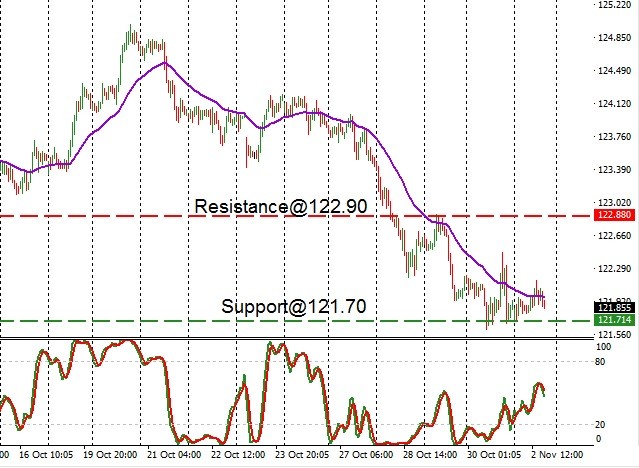
The Eurodollar remained range-bound against the Japanese yen yesterday despite the release of better-than-anticipated Eurozone final manufacturing PMI data. The au Jibun Bank Japan manufacturing PMI data indicated a contraction of the manufacturing sector in October, but the rate of contraction eased from the earlier month. This enabled the yen to hold its ground against the euro. In the past 24 hours, the EUR/JPY pair remained range-bound between 121.70 and 122.07.
According to the data published by IHS Markit, the au Jibun Bank Japan manufacturing PMI (Purchasing Managers’ index – final estimate) increased slightly to 48.70 in October, from 47.70 in September, and surpassed the reading of 48 anticipated by economists. The preliminary reading stood at 48. Even though the reading indicates a further weakening of the sector, the rate of contraction was the slowest since January.
Nonetheless, the reading represents the 22nd successive monthly, with enterprises citing the pandemic for the latest weakness. Fresh orders continued to remain in contraction territory. However, the rate of decrease slowed down to the lowest level since July 2019. Interestingly, in October, fresh export orders posted growth for the first time in roughly two years as demand increased overseas, particularly in the Asia-Pacific region. Worrisomely, job cuts increased in October.
Commenting on the latest survey results, Usamah Bhatti, Economist at IHS Markit, said: “October PMI data pointed to a further easing in the downturn across the Japanese manufacturing sector, as firms reported slower falls in output and new orders. […] An encouraging finding in October was the sustained improvement in business optimism.”
According to IHS Markit, Spanish manufacturing PMI (Purchasing Managers Index) increased to 52.50 in October, from 50.80 in September, and higher than the reading of 51 anticipated by economists.
The reported reading represents the second successive improvement in operating conditions. Specifically, manufacturing production rose for the fourth month in a row, with growth recording to the highest level since July.
In a separate release, the IHS Markit stated that Italian manufacturing PMI increased slightly to 53.80 in October, from 53.20 in the prior month, but a notch lower than the reading of 53.90 anticipated by economists. The reading represents a solid improvement in the condition of the manufacturing sector. Fresh export orders rose at a faster pace in three years. The country’s goods producers once again stepped up their buying activity. The rate of growth was the quickest in the past three months.
The IHS Markit also stated that French final manufacturing PMI inched higher to 51.30 in October, from 51.20 in September. Economists anticipated no change in the preliminary reading of 51. The recent reading was in accordance with the historical average. French firms continued to see an increasing inflow of orders at the beginning of the fourth quarter. Most of the sales were concentrated on the domestic market, with no significant improvement in fresh export orders in October.
Data published by IHS Markit indicates that German final manufacturing PMI increased to 58.20 in October, from 56.40 in the earlier month. The reported reading was slightly above the preliminary reading of 58. Economists did not anticipate any change in the preliminary reading. New orders contributed to the increase in the manufacturing PMI.
German manufacturers recorded the sharpest increase in new business since the institution started collecting the data in 1996. Rising exports to Asia, primarily China, assisted in boosting new export orders to the highest level since December 2017. Output across all three main industrial groups (consumer, intermediate, and investment goods) recorded steep growth.
The Eurozone final manufacturing PMI increased to 54.80 in October, from 53.70 in September, and surpassed the flash reading of 54.40. The reported reading was also the highest in 27 months and sustained the pattern of back-to-back growth that started in July.
While all industrial groups recorded solid growth, investment goods posting the most impressive expansion that hit a two year high. In the Eurozone, Austria recorded its best PMI reading in two years, while Italy posted a 31-month high reading.
Overall, the Eurozone recorded its fourth consecutive month of expansion in manufacturing production, with the pace of growth rising to the highest level in more than two-and-a-half-years. Fresh export orders increased at a significant rate and hit the best level since February 2018.
Looking forward to future production, business confidence stood positive for the fifth consecutive month. Specifically, Italian and German manufacturers had the most bullish view about the forthcoming 12 months.
The upbeat data from both the Eurozone and Japan is expected to keep the EUR/JPY range bound with a slight bullish bias.
The historical price chart indicates that the EUR/JPY pair has strong support at 121.70. The next resistance is anticipated only near 122.90. The stochastic oscillator is also ascending towards the bullish zone. Therefore, we are anticipating the currency pair to move up in the short-term.
Disclaimer: Any financial trading analysis offered here is our opinion and is not intended as advice or direction for investors. We cannot guarantee the success of any trades made as a consequence of this article, and we encourage traders to incorporate a strong money management strategy to limit losses when they enter the markets. Please use this article as part of your own research before formulating strategies prior to trading.


