The US dollar declined against the Canadian dollar despite the release of solid ADP non-farm employment change, Chicago PMI, and pending home sales data. The third GDP estimate confirming record high contraction of the US economy was one of the main reasons for the decline of the US dollar.
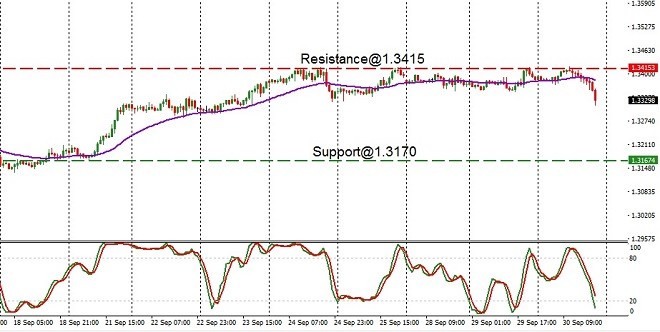
The solid Canada monthly GDP data and higher-than-anticipated decline in the US crude inventories also paved the way for the fall of the US dollar. In the last 24 hours, the USD/CAD pair declined from a high of 1.3415 to a low of 1.3315.
According to the data published by Automatic Data Processing, Inc., the US non-farm private sector added 749,000 jobs in September, following an addition of 481,000 jobs in the earlier month, and higher than the 650,000 job additions anticipated by economists.
The Institute of Supply Management-Chicago stated that the Chicago purchasing managers index surged to 62.40 in September, from 51.20 in the earlier month and surpassing the Consensus estimate of 52. The reported reading is the highest since December 2018 as business activity rebounded sharply. Through Q3, the business outlook also surged to 55.20, the highest reading since the first quarter of 2019.
All key indicators recorded gains in September, with production and new orders recording the maximum increase. On a q-o-q basis, supplier deliveries were the only category to post a decrease.
Production rose 16 points to a near two-year high. Output skyrocketed 29.20 points on a q-o-q basis in the third quarter, while demand surged 11 points in September. That took the new orders index to the highest level since November 2018. In the third quarter, new orders recorded the most significant increase of 32 points.
Order backlogs surged 14.4 points in September, while the quarterly index rose 16.70 points to reach the highest level since the first quarter of 2019. Inventories rose to a four-month high in September, even though the indicator remains below the reading of 50 since May. Despite the improvement in employment, layoffs continued in September. Through Q3, the employment index gained 8.10 points. Supplier deliveries inched up 2.80 points but declined 9.20 points in the third quarter.
Yesterday, the Bureau of Economic Analysis released the final GDP estimate for the second quarter. According to the third-estimate, the US economy shrank at an annual rate of 31.4% in the June quarter, compared with a contraction of 5% in the first quarter.
The previous estimate reported an economic contraction of 31.7%, and economists did not expect any change in that figure. The slight improvement in the final estimate was mainly due to an upward revision of personal consumption expenditures (PCE). The gains in PCE were partially offset by downward revisions to nonresidential fixed investments and exports.
Notably, current-dollar GDP fell 32.8% ($2.04 trillion) to $19.52 in the second-quarter. In the first-quarter, GDP contracted 3.4% ($186.30 billion).
Real gross domestic income (GDI) fell 33.50% in 2Q 2020, compared with a decline of 2.5% in 1Q 2020.
The final GDP Price Index, according to the Bureau of Economic Analysis, declined 1.8% q-o-q in the June quarter. The final estimate was slightly better than the reading of negative 2% reported in the earlier estimate. Economists had anticipated no change in the earlier reading.
According to the National Association of Realtors, pending home sales increased 8.8% m-o-m in August, following a growth of 5.9% in the previous month. The reported reading is more than twice the 3.1% growth anticipated by economists. Correspondingly, the Pending Home Sales Index increased to 132.80 in August. On a y-o-y basis, contract signings grew 24.2%.
Commenting on the pending home sales data, Lawrence Yun, NAR’s chief economist, said, “Tremendously low mortgage rates – below 3% – have again helped pending home sales climb in August. Additionally, the Fed intends to hold short-term fed funds rates near 0% for the foreseeable future, which should, in the absence of inflationary pressure, keep mortgage rates low, and that will undoubtedly aid homebuyers continuing to enter the marketplace.”
According to the Energy Information Administration, crude oil inventories decreased by 2 million barrels in the week ended September 26. In the earlier week, the US inventories (barring strategic reserves) declined 1.60 million barrels. Commodity analysts had anticipated an increase in the crude inventories by 1 million barrels. The US crude oil inventories, which are currently at 492.40 million barrels, are roughly 13% higher than the five year average for this time of year.
The Canadian economy, in the meanwhile, expanded 3% m-o-m in July, following a 6.5% growth in the prior month, as per data published by Statistics Canada. The third consecutive month of growth continued to nullify the sharp decline in economic activity recorded in March and April due to the COVID-19 related lockdown. Despite the improvement, the overall economic activity was still roughly 6% below the pre-pandemic February level.
All 20 industrial sectors recorded growth in July as utilities, agriculture, insurance, and finance eclipsed pre-pandemic February levels. Notably, in June itself, retail trade surpassed pre-pandemic February levels.
The manufacturing industry expanded 5.9% in July, after recording a 15.1% growth in June as factories continued to ramp up production. Nevertheless, manufacturing activity was still roughly 6% below the February level.
Durable manufacturing increased 5.7%, reflecting the third successive monthly increase, as 7 of the 10 subsectors grew in July. Transportation equipment manufacturing led the increase with a 16.6% surge in growth. Likewise, motor vehicle parts manufacturing posted a 38.6% growth. However, ship and boat building posted a 7.9% drop, while electronic goods manufacturing recorded a 4.5% decline.
Non-durable manufacturing expanded 6.2% as all but one sub-sectors posted growth. Textile and textile product mills recorded a 9% decline. Plastic and rubber products recorded the highest growth of 17.9%.
The public sector grew 2.5% in July as all three constituents (healthcare, educational services, and social assistance) recorded growth.
Accommodation and food services surged 20.1% in July, reflecting the third successive double-digit monthly growth, following a steep drop in March and April. Real estate and rental and leasing posted an expansion of 1.9% in July. Wholesale trade increased 4.6% in July as all nine subsectors were up.
Likewise, the transportation and warehousing sector grew 5.7% as all 10 subsectors performed impressively. For the third month in a row, the professional services sector expanded (2.8%) in July. The price of crude oil increases when there is a decline in inventories. Furthermore, the crude oil price has an inverse correlation with the US in the absence of an inflationary dollar.
Therefore, despite the impressive ADP non-farm employment change and pending home sales data, the US dollar is expected to remain weak in the days ahead.
Technically, the USD/CAD pair is declining after facing resistance at 1.3415. The next support is anticipated only near 1.3170. Furthermore, the currency pair is trading below its 50-day moving average, and the stochastics indicator is in the bearish zone. Therefore, the USD/CAD pair is expected to remain in a downtrend in the short-term.
Disclaimer: Any financial trading analysis offered here is our opinion and is not intended as advice or direction for investors. We cannot guarantee the success of any trades made as a consequence of this article, and we encourage traders to incorporate a strong money management strategy to limit losses when they enter the markets. Please use this article as part of your own research before formulating strategies prior to trading.