The Eurodollar gained ground against the kiwi dollar yesterday despite the report of a flat current account surplus data for October, compared with earlier months. Notably, Statistics New Zealand had reported a better-than-anticipated trade deficit in the Asian session.
However, the change to trade deficit in the year ended November 2021, from a trade surplus in the comparable period last year, enabled the Eurodollar to gain ground against the Kiwi dollar. Additionally, the ECB’s announcement last week to scale back its €1.85 trillion asset purchase program (Pandemic Emergency Purchase Program) between March and October 2022 also fueled the Eurodollar’s rise. Overall, the EUR/NZD pair rallied from a low of 1.6660 to a high of 1.6800 in the last 24 hours.
According to Statistics New Zealand, the country’s trade deficit narrowed to N$864 million in November, from N$1.302 billion in the prior month, and bettered the N$1.867 billion deficit anticipated by economists. Notably, the country had recorded a surplus of N$277 million in November 2020.
Exports rose by N$668 million (or 13%) to N$5.90 billion. Export of milk powder, cheese and butter posted an increase of N$258 million (or 14%) to N$2.10 billion. Also, aluminum and aluminum articles recorded a growth of N$141 million (or 151%).
Meat and edible offal reported a rise of N$97 million (or 17%) to N$660 million. Wine gained by N$67 million (or 46%). However, aircraft and parts recorded a decline of N$113 million (or 89%), food preparations posted a drop of N$82 million (or 36%). Respiratory equipment reported a decrease of N$51 million (or 41%).
Likewise, imports surged by N$1.80 billion (or 37%) to N$6.70 billion. Imports of mechanical machinery and equipment surged N$244 million (or 36%). Vehicles, parts, and accessories posted a rise of N$187 million (or 32%). Petroleum and products reported an increase of N$150 million (or 53%). Ships, boats, and floating structures recorded a rise of N$146 million. However, imports of fertilizers fell by N$12 million (or 14%).
Exports to China rose by N$262 million (or 13%) to N$2.30 billion. Likewise, exports to Australia increased N$131 million (or 21%) to N$746 million. Also, exports to the US grew by N$29 million (or 5.50%) to N$560 million.
Likewise, imports from China increased N$552 million (or 45%) to N$1.80 billion. Furthermore, imports from the EU surged N$270 million (or 38%) to N$972 million. Also, imports from Australia grew by N$164 million (or 28%) to N$759 million.
New Zealand’s goods exports increased N$2.70 billion y-o-y to N$62.80 billion in the year ended November 2021. Similarly, imports rose by N$12 billion y-o-y to N$68.80 billion. Overall, the trade deficit was N$6 billion in the year ended November 2021. Notably, in the year ended November 2020, the country had recorded a surplus of N$3.30 billion.
According to the European Central Bank, the Eurozone’s current account surplus was €18.10 billion in October, unaltered from the prior month, but missed the €20.30 billion surplus anticipated by economists.
While goods surpluses were €16 billion in October, services surplus were €16 billion during the same period. This was partially negated by a secondary income deficit of €15 billion.
In the year ended October 2021, the Eurozone’s current account surplus was €311 billion (or 2.60% of GDP), an increase from €186 billion (or 1.60%) in the year ended October 2020. The increase was led by a shift in the services balance to a surplus of €98 billion, from a deficit of €28 billion.
Additionally, the primary income surplus increased to €53 billion in October, from €35 billion in the prior month. Goods surplus rose to €331 billion, from €327 billion. This was partly negated by a widened deficit of €170 billion in October, from €148 billion in the prior month.
The Eurozone residents made net investments of €22 billion in non-Eurozone assets in the year ended October 2021. This compares with investments of €75 billion in the year ended October 2020.
In portfolio investment, the Eurozone residents’ net purchases of non-Eurozone equity rose to €487 billion in the year ended October 2021, an increase from €215 billion in the year ended October 2020. During the same period, net purchases of non-Eurozone debt securities by the Eurozone residents rose to €450 billion, an increase from €278 billion in the year ended October 2020.
Overall, the Eurosystem’s reserve asset holdings increased to €1.019 trillion in October, from €1.002 trillion in September.
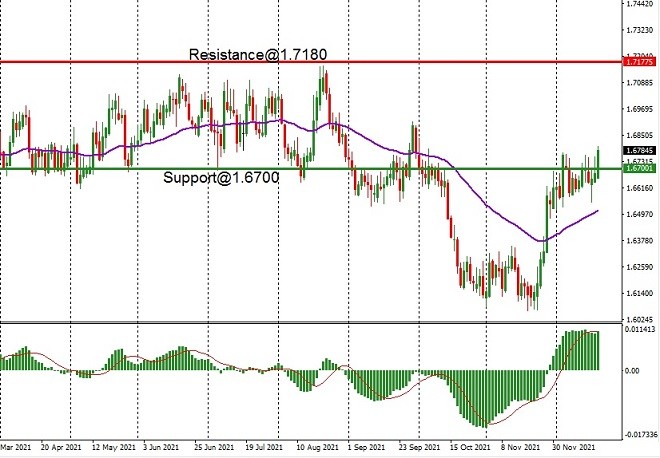
The historical price chart indicates that the EUR/NZD pair is rising after testing the support at 1.6700. The next resistance is anticipated only near 1.7180. Additionally, the currency pair is trading above its 50-day moving average, while the MACD indicator has a positive reading. Therefore, we are anticipating the currency pair to remain in an uptrend in the short term.
Disclaimer: Any financial trading analysis offered here is our opinion and is not intended as advice or direction for investors. We cannot guarantee the success of any trades made as a consequence of this article, and we encourage traders to incorporate a strong money management strategy to limit losses when they enter the markets. Please use this article as part of your own research before formulating strategies prior to trading.