The US dollar started Wednesday with gains versus the yen as Japan’s Cabinet Office reported unexpectedly low core machinery orders and lower-than-anticipated trade surplus data. However, the greenback lost all its gains in the US session as the Census Bureau reported lower-than-expected building permits and housing starts data.
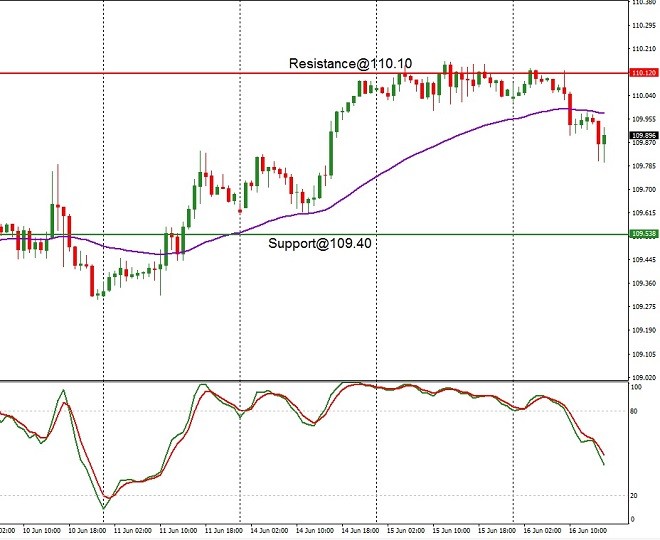
The USD/JPY pair declined from a high of 110.14 to a low of 109.80 in the last 24 hours.
The Japanese Cabinet Office stated that core machinery orders, which exclude ships and other volatile goods, increased 0.6% m-o-m in April, following a rise of 3.7% in the earlier month, but missed the 2.7% growth anticipated by economists polled by Thomson Reuters.
On a y-o-y basis, core machinery orders rose by 6.5% in April, compared with an 8% rise anticipated by economists.
Notably, the orders have increased for the second successive month. In value terms, the core machinery orders aggregated ¥802.87 billion (~$7.30 billion).
Machinery orders are a major indicator for corporate capital spending, and the government utilizes the data to forecast the robustness of business spending over the next six to nine-month period. Usually, the business investment represents about 15% of Japan’s GDP.
As per the data published by the Japanese Ministry of Finance, the trade surplus was ¥0.04 trillion in May, compared with ¥0.08 trillion in April. The reported figures missed the ¥0.24 trillion anticipated by economists.
The country’s exports surged 49.6% y-o-y in May, reflecting the steepest monthly rise in over four decades, primarily due to solid demand for automobiles and parts. Goods exports reached ¥6.26 trillion ($56.85 billion), representing the quickest rate of rising since April 1980 when exports surged 51.40%.
Exports grew for the third consecutive month in May 2021, mainly due to over 28% y-o-y drop recorded in May 2020 against the backdrop of the COVID-19 pandemic that caused a slump in demand in addition to supply chain issues. Imports also rose by 27.9% to ¥6.45 trillion (~58.58 billion), accounting for the fourth successive monthly rise.
For the first time in four months, Japan’s goods trade surplus with the rest of the world recorded a deficit of ¥187.15 billion (~1.69 billion).
In the US session, the Census Bureau reported a decline in the building permits to 1,681,000 units in May, from 1,733,000 units in April, but 34.9% higher than the 1,246,000 units reported for May 2020. The reported figure missed economists’ estimates of 1,730,000 units. Single-family authorizations were 1,130,000 units in May, down 1.6% from the 1,148,000 units in April.
Housing starts were 1,572,000 units in May, an increase of 3.6% from 1,517,000 units in April and 50.30% higher than the 1,046,000 units posted in May 2020. The reported figure missed the 1,640,000 units anticipated by economists. Single-family housing starts were 1,098,000 units in May, up 4.2% from the 1,054,000 units recorded for April.
Housing completions stood at 1,368,000 units in May 2021, down 4.1% from 1,426,000 units in April, but 16.1% higher than the 1,178,000 units in May 2020.
The weak economic data from both the US and Japan is expected to keep the USD/JPY pair range-bound with a slight bearish bias.
The historical price chart indicates that the USD/JPY pair is declining after facing resistance at 110.10. The next minor support is anticipated only near 109.40. Additionally, the currency pair is trading below its 50-day moving average, while the stochastic oscillator is descending towards the bearish zone. Therefore, we are anticipating the currency pair to remain in a downtrend in the days ahead.
Disclaimer: Any financial trading analysis offered here is our opinion and is not intended as advice or direction for investors. We cannot guarantee the success of any trades made as a consequence of this article, and we encourage traders to incorporate a strong money management strategy to limit losses when they enter the markets. Please use this article as part of your own research before formulating strategies prior to trading.