

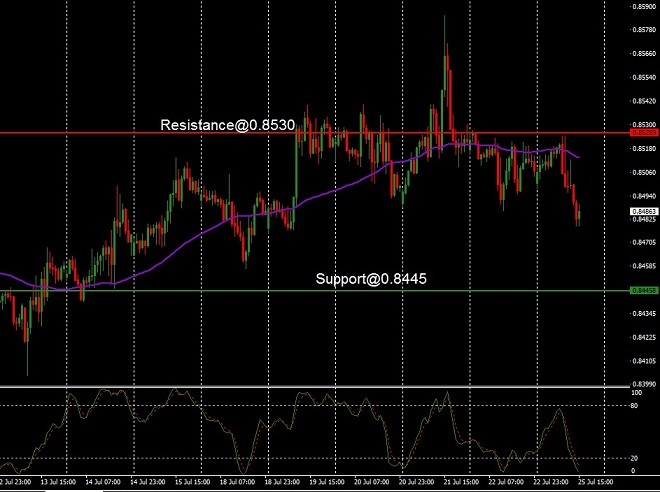
The euro lost ground against the British pound on the report of more than two-year low business climate index data for July. The Confederation of British Industry’s order book balance also hit a one-year low. However, the market was concerned about the increasing issues faced by Europe due to the ongoing Ukraine-Russia conflict. This kept the euro weak against the pound. Overall, the EUR/GBP declined from a high of 0.8530 to a low of 0.8486 in the past 24 hours.
As per data published by the Ifo Institute, the country’s business climate index declined to 88.60 in July, from 92.20 in June, and missed the reading of 90.20 anticipated by economists. The reported reading reflects the lowest level in more than two years as surging energy prices and gas scarcity have raised concerns about the economy.
The current situation index also fell to 97.70 in July, from 99.40 in June. The indicator evaluating the company’s anticipations decreased to 80.30, from 85.80. Sentiment worsened across all categories of business.
Specifically, the manufacturing sentiment index decreased to -7.10 in July, after remaining unchanged in June. New orders fell for the first time in two years. Pessimism about the upcoming months has reached the highest level since April 2020.
The services index fell to 0.90, from 10.90. The trade index worsened to -21.60, from -14.70. The mood has turned dull even in the tourism and hospitality industry.
The construction index declined to -17, from -9.50, reflecting the lowest level since April 2016. As per the data published by the Confederation of British Industry, the order book balance declined to 8 in July, from 18 in June. The reported reading reflects the lowest level since April 2021. Also, July’s reading was worse than the market’s expectation of 13.
Export orders declined, with the corresponding index falling to -12 in July, from 1 in June. Stocks of finished goods decreased to -7, from 2. Output expectations dropped to 6, from 20. Domestic price growth also recorded a decrease, with the corresponding index falling to 48, from 58. For a third consecutive quarter, business sentiment declined, with the corresponding index at -21, compared with -34 in the quarter ended April.
In the quarter to July, output volumes logged the slowest rate (since the quarter to April 2021, at 6%, compared with 25% in the quarter to June. The market also expects only a similar rate of growth, i.e., 6% in the three months to October. Ten out of 17 sub-sectors posted an increase in output.
Notably, in comparison to April, investment intentions for the year ahead increased. Specifically, plants and machinery recorded an increase of 17%, from 9%. Also, the employee count increased by 18% in the quarter to July, compared with 21% in the quarter ended April. Business owners expect the rate to be almost unchanged (19%) in the upcoming three months.
The poor economic data from both the UK and Europe is anticipated to keep the EUR/GBP pair range bound in the short term.
The historical price chart shows that the EUR/GBP pair is declining after facing resistance at 0.8530. The next support is expected only near 0.8445. Additionally, the currency pair is trading below its 50-day moving average, while the stochastics indicator is in the bearish zone. Consequently, we predict the currency pair to remain in a downtrend in the short term.
Disclaimer: Any financial trading analysis offered here is our opinion and is not intended as advice or direction for investors. We cannot guarantee the success of any trades made as a consequence of this article, and we encourage traders to incorporate a strong money management strategy to limit losses when they enter the markets. Please use this article as part of your own research before formulating strategies prior to trading.


