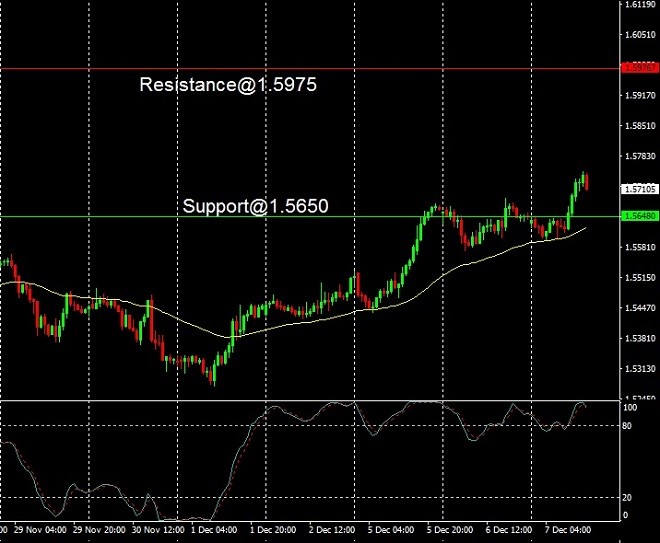
The euro gained ground against the Aussie following the release of better-than-anticipated Eurozone GDP data for the September quarter. The Australian dollar’s sell-off was also fueled by slightly lower-than-anticipated economic growth in the third quarter. Overall, the EUR/AUD pair rallied from a low of 1.5650 to a high of 1.5749 in the past 24 hours.
According to the data published by the Australian Bureau of Statistics, the country’s economy grew by 0.60% q-o-q in the September 2022 quarter, following a 0.90% GDP growth in the prior quarter and a notch lower than forecasts of a 0.70% increase. The reported figure reflects the fourth successive quarter of economic growth.
On a y-o-y basis, GDP grew by 5.90% in September 2022. The economic growth was primarily led by robust household spending.
The terms of trade declined 6.60% in the September 2022 quarter. While export prices fell by 2.80%, import prices grew by 4.10%. Exports of goods and services delivered 0.60% of the GDP. Likewise, exports of services surged 10.60%, signaling a rebound in education and personal travel as students and tourists returned from across the globe. Exports of goods rose by 1.40%, led by rural goods. Imports shaved off 0.80% of GDP growth. In particular, imports of services surged by 16.20%.
Household spending increased 1.10% q-o-q in September 2022 quarter, led by discretionary goods and services. Hotels, cafes, and restaurants grew by 5.50%. Transport services surged 13.90%. Purchase of vehicles jumped 10.10%.
Gross operating surplus plus gross mixed income (GOSMI) declined by 2.20%. Compensation of employees (COE) increased by 3.20% q-o-q in September 2022 quarter, the strongest increase since December quarter 2006. Also, the household saving ratio fell to 6.90%, from 8.30%.
According to Destatis, German industrial production contracted 0.10% m-o-m in October, following an increase of 1.10% (preliminary estimates pegged growth at 0.60%) in the prior month but bettered forecasts of a 0.60% decline.
On a y-o-y basis, the country’s industrial production remained flat in October 2022.
Excluding energy and construction, industrial production declined 0.40% m-o-m in October. Production of capital goods rose by 1.40%. Likewise, the production of consumer goods decreased by 1.90%. Also, the production of intermediate goods dipped by 1.80%. Energy production fell by 7.60% m-o-m in October while construction output grew by 4.20% in the same period.
According to the data published by Eurostat, the Eurozone’s economy expanded 0.30% q-o-q in the September 2022 quarter, following a 0.80% GDP growth in the June 2022 quarter and greater than the 0.20% economic expansion reported in the initial estimate. Economists did not anticipate any change in the preliminary estimate.
On a y-o-y basis, the Eurozone GDP rose by 2.30% in September 2022.
The Eurostat also stated that the number of employed people rose by 0.30% q-o-q in the September 2022 quarter, following an increase of 0.3% in the June 2022 quarter. The preliminary estimates had pegged the employment change at 0.20%. The market did not anticipate any change in the preliminary estimates.
On a y-o-y basis, the Eurozone employment jumped 1.80% in 3Q 2022.
The better-than-anticipated Eurozone economic data is expected to keep the EUR/AUD pair range bound with a slight bullish bias in the days ahead.
Technically, the EUR/AUD pair is rising after testing the support at 1.5650. The next resistance is anticipated only near 1.5975. Additionally, the currency pair is trading above its 50-day moving average while the stochastic indicator is in the bullish zone. Therefore, we anticipate the EUR/AUD pair to remain in an uptrend in the days ahead.
Disclaimer: Any financial trading analysis offered here is our opinion and is not intended as advice or direction for investors. We cannot guarantee the success of any trades made as a consequence of this article, and we encourage traders to incorporate a strong money management strategy to limit losses when they enter the markets. Please use this article as part of your own research before formulating strategies prior to trading.