

The greenback continued to lose ground against the euro yesterday following the release of weak US producer price index data for July. The euro’s rally was also stoked up by slightly higher than anticipated first-time unemployment claims. There were no other major economic releases yesterday. Overall, the EUR/USD pair rallied from a low of 1.0275 to a high of 1.0350 in the past 24 hours.
According to the Bureau of Labor Statistics, the country’s PPI (producer price index) fell by 0.50% m-o-m in July, following a rise of 1% in the prior month and disappointing economists who were expecting an increase of 0.20% in the reported period.
The decline was led by a 1.80% drop in prices for final demand goods, reflecting the steepest drop since April 2020, when final demand goods fell by 2.70%. Specifically, in July, the decline was fueled by a 9% fall in prices for final demand energy.
However, the index for final demand for foods increased 1%. Likewise, the index for final demand goods (excluding foods and energy) grew by 2%.
On a year-on-year basis, final demand prices surged 9.80% in July 2022.
The index for final demand services rose by 0.10%, mirroring the third successive growth in a row. The increase was led by a 0.3% increase in margins for final demand trade services. Also, prices for final demand transportation and warehousing services inched up 0.40%. On the contrary, final demand services, excluding trade, transportation, and warehousing, fell by 0.10%.
Excluding foods, energy, and trade services, the core PPI inched up 0.20% m-o-m in July, following a rise of 0.30% in June, and missed the 0.40% growth anticipated by economists. For the year ended July, the index for final demand (excluding foods, energy, and trade services) grew by 5.80%.
According to the US Department of Labor, the country’s first-time unemployment claims rose to 262,000 in the week ended August 6, from 248,000 (downwardly revised from 260,000) in the prior week. The reported jobless claims, near the highest level since November, were slightly lower than the 264,000 claims anticipated by economists.
The four-week moving average stood at 252,000, up from 247,500 (downwardly amended from 254,750) in the earlier week. The weak PPI data and an increase in unemployment claims are expected to keep the greenback weak against its rivals, including the euro.
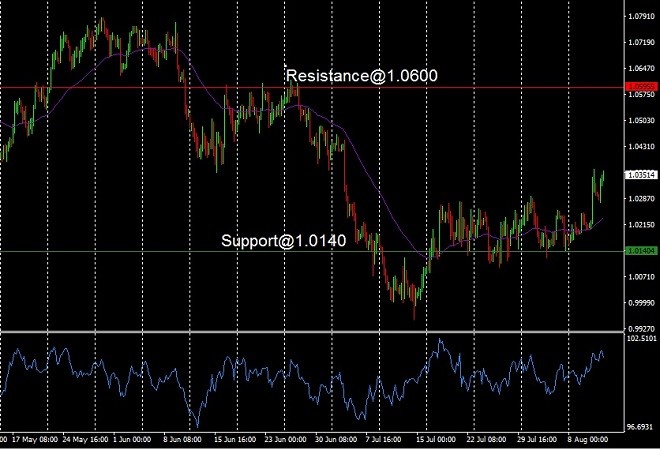
The historical price chart indicates that the EUR/USD currency pair is rising after testing the support at 1.0140. The next major resistance is anticipated only near 1.0600. Additionally, the currency pair is trading above its 50-day moving average while the momentum indicator is rising. Therefore, we are anticipating the EUR/USD pair to remain in an uptrend in the near term.
Disclaimer: Any financial trading analysis offered here is our opinion and is not intended as advice or direction for investors. We cannot guarantee the success of any trades made as a consequence of this article, and we encourage traders to incorporate a strong money management strategy to limit losses when they enter the markets. Please use this article as part of your own research before formulating strategies prior to trading.


