
The pound remained range-bound against the greenback yesterday following the release of upbeat economic data from both the UK and US. While the UK’s services PMI data for December reflected another month of expansion, the US non-farm payrolls data blew away estimates. Overall, the GBP/USD pair traded between 1.2663 and 1.2724 in the past 24 hours.
According to the final data published by S&P Global, the UK’s services PMI (purchasing managers’ index) rose to 53.40 in December from 50.90 in November. The preliminary estimates had pegged the reading at 52.70. Economists did not anticipate any change in the preliminary reading. The reported reading reflects the second successive month of expansion (a reading above 50 indicates growth and vice versa).
Robust business activity, specifically by tech and financial services providers, paved the way for the increase. Fresh order volumes grew in December, reflecting signs of an increase in clients’ inclination to spend.
The latest reading also signals the quickest rebound in fresh work since June 2022. Export sales remained sluggish as aggregate new orders from overseas rose only slightly. Employment declined in December, mirroring the third decrease in four months.
As there was no pressure on operating capacity, work backlogs fell modestly in December. This is the seventh successive month of declining backlogs spanning the service economy. Around 51% of the survey participants expect a rise in business activity in the year ahead. Only 12% anticipate a decline. The overall degree of business optimism rose to the highest level since last May.
According to the Bank of England, the UK’s mortgage approvals rose to 50,100 in November, reflecting the highest level in five months, from 47,900 in October, which surpassed forecasts of 48,000. Net approvals for remortgaging grew to 27,000 in November from 24,000 in October.
Net borrowing by individuals was £2.0 billion in November, an increase from £1.4 billion in October. Notably, households deposited £3.4 billion with banks and building societies in the reported period. Furthermore, the UK’s non-financial businesses repaid £1.6 billion of loans in November, following repayments of £1.8 billion in October.
The ‘effective’ interest rate was 5.34% in November, an increase of 9 basis points from October.
According to the data published by Automatic Data Processing, Inc., US non-farm payrolls increased by 164,000 in December following an addition of 101,000 jobs in the previous month and surpassed forecasts of 120,000.
While the goods-producing sector added 9,000 jobs, the service-providing sector added 155,000 jobs.
Under the goods-producing sector, the construction sector added 24,000 jobs. However, the manufacturing sector lost 13,000 jobs.
In the service-providing sector, education and health services added 42,000 jobs. Likewise, the leisure and hospitality sector added 59,000 jobs. Also, financial activities and the trade, transportation, and utilities sectors added 18,000 and 15,000 jobs, respectively.
According to the data published by the US Department of Labor, the country’s first-time unemployment claims declined to 202,000 in the week ended December 30 from 220,000 (upwardly revised from 218,000) in the previous week and bettered forecasts of 217,000. The four-week moving average fell to 207,750 from 212,500 (upwardly revised from 212,000) in the earlier week.
The upbeat economic data from both countries is expected to keep the GBP/USD pair range-bound in the near term.
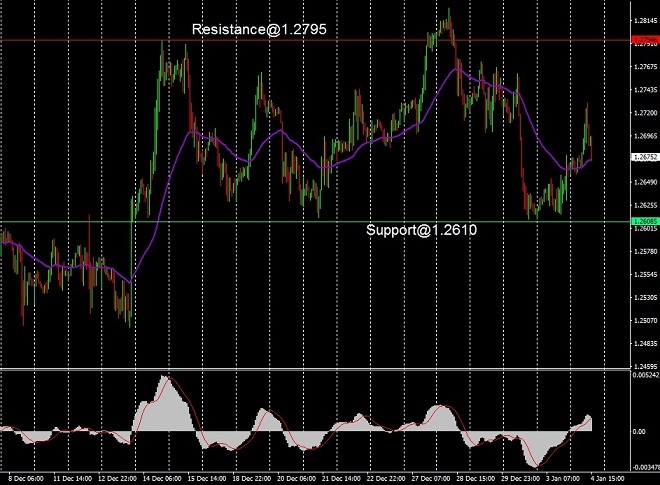
The historical price chart indicates that the GBP/USD pair is ascending after testing the support at 1.2610. The next resistance is anticipated to be only near 1.2795. Additionally, the currency pair is trading above its 50-day moving average, while the MACD indicator is showing a positive reading. Therefore, we anticipate the GBP/USD pair to remain in an uptrend in the near term.
Disclaimer: Any financial trading analysis offered here is our opinion and is not intended as advice or direction for investors. We cannot guarantee the success of any trades made as a consequence of this article, and we encourage traders to incorporate a strong money management strategy to limit losses when they enter the markets. Please use this article as part of your own research before formulating strategies prior to trading.