The pound rallied against the greenback on Friday after the US building permits and housing starts data for January missed estimates. The pound’s uptrend was also cemented by the robust UK retail sales data for January, signaling recession will be short-lived. Overall, the GBP/USD pair rallied from a low of 1.2550 to a high of 1.2620 in the past 24 hours.
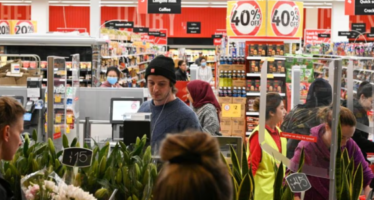
As per the data published by the Office for National Statistics, the UK’s retail sales rebounded with a growth of 3.40% m-o-m in January following a 3.30% decline in the previous month and more than double the forecasts of 1.50%.
This was the largest monthly rise since April 2021 and returned volumes to November 2023 levels.
All subsectors, devoid of clothing, recorded an increase in sales volumes. The majority of the increase was delivered by food stores.
Sales volumes declined by 0.20% in the three months to January compared with the earlier three months. Nevertheless, this was the smallest decline since August 2023.
While sales volumes grew by 3.40% in January, sales values rose by 3.90% in the same period.
On a y-o-y basis, sales volumes inched up 0.70% in January 2024. However, it is still 1.30% lower than the pre-COVID-19 level (February 2020).
Food store sales volumes rebounded with a growth of 3.40% m-o-m in January, following a 3.10% decline in December. On a y-o-y basis, food store sales volumes inched up 0.60% in January.
Likewise, non-food store sales volumes grew by 3% m-o-m in January, following a 3.90% decline in December.
Department stores and other non-food stores saw sales volumes increase by 5.40% and 6.20%, respectively. Household goods stores posted a growth of 1.80% in January. Also, automotive fuel posted an increase of 5.40%. However, clothing stores declined by 1.40%.
Online spending fell by 4.10%m-o-m in January but rose by 1% on a y-o-y basis. The percentage of online sales declined to 24.80% in January, from 26.80% in December.
According to the US Census Bureau, the country’s building permits fell 1.50% to 1,470,000 units in January from 1,493,000 units in the previous month and missed forecasts of 1,510,000 units.
The reported figure is 8.60% higher than the January 2023 rate of 1,354,000 units.
The Census Bureau has also stated that housing starts declined 14.80% to 1,331,000 units in January from 1,562,000 units in December, and missed forecasts of 1,450,000 units.
The reported figure is 0.70% lower than the January 2023 rate of 1,340,000 units.
According to the US Bureau of Labor Statistics, the country’s PPI (producer price index) inched up 0.30% m-o-m in January following a decline of 0.10% in December and surpassed forecasts of 0.10% growth.
The final demand prices increased by 0.60% m-o-m in January, while the final demand for goods declined by 0.20% in the same period.
On a y-o-y basis, the US PPI grew by 0.90% in January 2024.
Excluding foods, energy, and trade services, the PPI inched up 0.6% m-o-m in January, the largest increase since January 2023. On a y-o-y basis, the PPI, excluding foods, energy, and trade services, surged 2.60% in January 2024.
The weak US economic data coupled with overwhelmingly positive UK retail sales data is expected to keep the GBP/USD pair range-bound with a slight bullish bias in the short term.
Technically, the GBP/USD pair is ascending after testing the support at 1.2540. The next resistance is anticipated to be only near 1.2715. Additionally, the currency pair is trading above its 50-day moving average, while the stochastic indicator is in the bullish zone. Therefore, we anticipate the GBP/USD pair to remain in an uptrend in the near term.

Disclaimer: Any financial trading analysis offered here is our opinion and is not intended as advice or direction for investors. We cannot guarantee the success of any trades made as a consequence of this article, and we encourage traders to incorporate a strong money management strategy to limit losses when they enter the markets. Please use this article as part of your own research before formulating strategies prior to trading.