
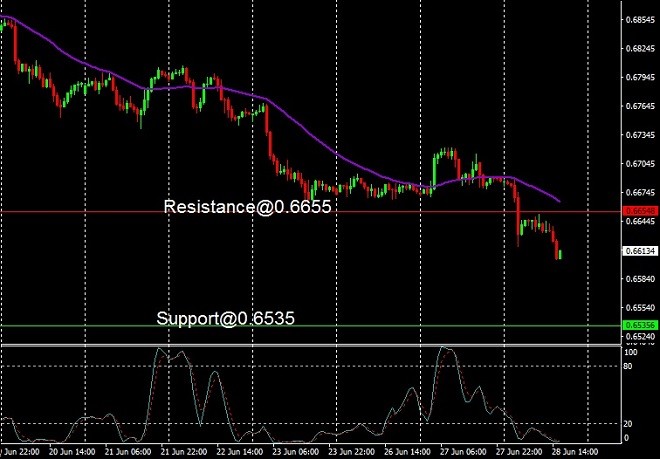
Yesterday, the Australian dollar experienced a decrease in value against the US dollar, prompted by the release of consumer price index data for May that fell short of expectations. This outcome suggests a reduced probability of the Reserve Bank of Australia implementing another interest rate increase. Additionally, the Australian dollar’s decline was influenced by a US goods trade deficit that was lower than anticipated during the same timeframe. In the past 24 hours, the AUD/USD pair dropped from a peak of 0.6655 to a trough of 0.6604.
According to the data published by the Australian Bureau of Statistics, the country’s consumer price index increased 5.60% y-o-y in May following a gain of 6.80% in the previous month but missed forecasts of a 6.10% rise. The reported figure indicates a 13-month low.
The increase was led by an 8.40% y-o-y increase in housing prices. Similarly, food and non-alcoholic beverages recorded a growth of 7.90%. Additionally, the furnishings, household equipment, and services group posted an increase of 6%. This was partly negated by an 8% drop in automotive fuel.
Excluding volatile goods (fruit and vegetables, automotive fuel) and travel, the CPI increased 6.40% y-o-y in May, compared with a 6.50% rise in the previous month.
New dwelling prices increased 8.30% in the year ended May, reflecting high material and labor expenses. Rent costs surged 6.30% y-o-y in May 2023, an increase from 6.10% in April, indicating robust demand for rental assets. Food and non-alcoholic beverages grew by 7.90% y-o-y in May.
Automotive fuel prices declined 8% y-o-y in May. However, on a m-o-m basis, automotive fuel prices declined 6.70% in May against the backdrop of a rise in oil production and a higher Australian dollar that pushed down the cost of imports. Holiday travel and accommodation grew by 7.30% y-o-y in May, a decline from 11.90% in April. On an m-o-m basis, holiday travel and accommodation prices declined by 11.30%, led by domestic holiday travel and accommodation.
Insurance prices experienced a notable surge of 14.2% y-o-y in May, representing a significant rise from 8.7% in April. This represents the most significant yearly increase on record, indicative of elevated premiums for insurance policies covering residences, personal belongings, and automobiles.
According to the US Census Bureau, the country’s goods trade deficit narrowed to $91.10 billion in May from 97.10 billion in the previous month and bettered forecasts of a $93.30 billion deficit.
The value of goods exported was $162.80 billion in May, down $1 billion from April. Likewise, the value of goods imported was $254 billion in May, a decrease of $6.90 billion from April.
Exports declined by 0.60%, primarily due to a 14.20% slump recorded by foods, feeds, and beverages. Exports of industrial supplies fell by 3%. However, exports of vehicles jumped 8.70%. Likewise, consumer goods posted a rise of 4.30%.
The 2.70% decline in imports was led by a 7.30% decrease reported by the consumer goods sector. Additionally, imports of industrial supplies fell by 5.90%.
The preliminary data published by the Census Bureau indicated that wholesale inventories fell by 0.10% m-o-m in May to $912.90 billion, following a decline of 0.30% in April and in line with economists’ estimates. On a y-o-y basis, US wholesale inventories rose by 3.60% in May 2023.
The inventories of non-durables fell by 1% in May, following a 1.70% decrease in April. Also, inventories of durable goods rose by 0.50% in May, following a 0.60% growth in April.
Retail inventories inched up 0.80% m-o-m in May to $778.70 billion, following an increase of 0.30% in the previous month. On a y-o-y basis, US retail inventories surged 7% in May 2023.
In the near future, it is anticipated that the AUD/USD pair will remain within a limited range due to the positive economic data coming out of the United States.
The historical price chart indicates that the AUD/USD pair is descending from a high of 0.6655. The next support is anticipated to be near 0.6535. Additionally, the currency pair is trading below its 50-day moving average, while the stochastic indicator is in the bearish zone. Therefore, we anticipate the AUD/USD pair to remain in a downtrend in the short term.
Disclaimer: Any financial trading analysis offered here is our opinion and is not intended as advice or direction for investors. We cannot guarantee the success of any trades made as a consequence of this article, and we encourage traders to incorporate a strong money management strategy to limit losses when they enter the markets. Please use this article as part of your own research before formulating strategies prior to trading.