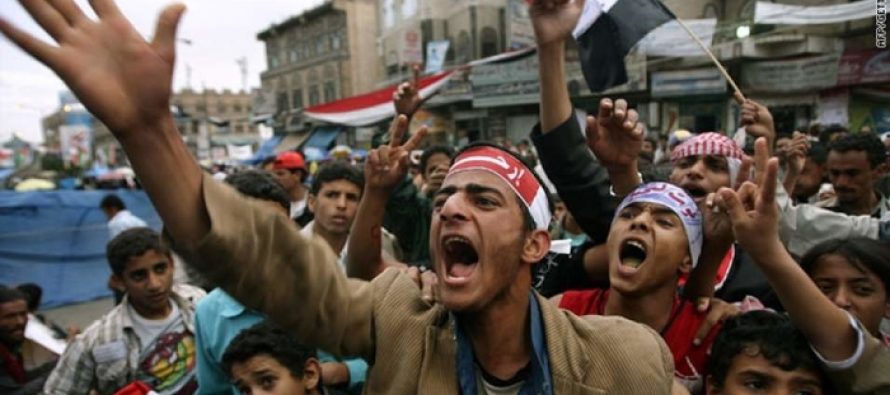
The Yemeni rial plunged to 620 a dollar yesterday as demonstrators took to the streets to protest against the deteriorating economic situation in the war-torn country. The protestors added to the pollution by burning tires on roads, paralyzed traffic in the southern city of Aden, and forcibly shut down shops and government offices.
In an attempt to manage the weakening fiscal situation, the country’s internationally recognized government ordered a temporary ban on the import of luxury goods like automobiles on Sunday, and in an effort to gain the support of the general public the government has also ordered a 30% raise in salary for public-sector employees, including contractors and pensioners.
Yemen civil war and its impact on the currency
In 2004 a military rebellion resulted in a small-scale conflict between Zaidi Shia Houthis and the Yemeni military in Northern Yemen which later escalated into a full-fledged civil war. Referred to as the Houthi insurgency aka Houthi rebellion (or Sa’dah war), the conflict began when the government tried to arrest Hussein Badreddin al-Houthi, a revered Zaidi religious leader of the Houthis and an ex-parliamentarian.
The government also placed a bounty of $50,000 on Hussein Badreddin al-Houthi’s head. The intricacies of the conflict changed completely with the Houthi takeover of major parts of Yemen. Saudi Arabia came into the picture in 2015 after it started supporting Abd-Rabbu Mansour Hadi, the Yemeni President in exile. In simpler terms, the war can be classified as the battle between the government of President Abd-Rabbu Mansour Hadi, based out of South Yemen and backed by Saudi Arabia, and the Iran-backed Houthi movement that reigns over the north, including Sanaa, the country’s capital.
Yemen is one of the poorest Arab countries, and the insurgency has brought the country to the brink of complete collapse. The nation is struggling to counter hunger and the spread of disease. The protests that have been occurring since Sunday have brought the country’s busy markets to its knees. Additionally, the coordinating council of the General Confederation of Southern Workers Unions has called for civil disobedience on a daily basis from 6 am to 2 pm, barring Fridays, until the present government steps down, and the price of consumer goods is decreased.
The war, alongside the inflationary effects, have made the currency lose more than half its value against the greenback since the beginning of the civil war in 2015. When finance officials resorted to increasing liquidity in the system in 2017, the rial depreciated to 350 per dollar from 250. By the end of December 2017, the rial was trading at 440 per dollar but declined to 500 in January 2018. To prevent the rial from weakening further, Saudi Arabia deposited $2 billion in Yemen’s central bank, however, the currency succumbed to economic instability. Last Sunday, the rial hit a new low of 610 to the dollar.
The depreciation of the rial has made the cost of living skyrocket throughout the country, and most of the commodities are now out of financial reach for a majority of Yemenis. The central bank is struggling to pay salaries to the public sector as foreign exchange is scarce. Hadi, who has been living in Riyadh since 2015, has ordered the government’s economic committee to draft a plan to bail the country out of the problematic situation.
In addition to the import ban and hike in salary, the government has ordered an increase in oil production in the Hadramout province, but there are no precise figures regarding the increase in the quantum of oil that is being pumped out of the Maila oilfields. Hadi has also ordered an increase in the export of oil from the Shabwa province.
It has furthermore been advised that measures should be implemented to export gas. These details were publicized through a tweet by the Information Minister Moammar-al-Eryani. The government is also planning to shut down unregistered money exchangers, and even governmental organizations require a license to access the foreign exchange market.
To assist in resolving the issue, the UN has convened for talks in Geneva on Thursday. Hadi’s officials have however now stated that there won’t be any “face-to-face” talks and there would only be discussions on a prisoner exchange agreement and the future of the main port. As a result, hopes of a resolution have faded once again, and a further decline in the Yemeni rial can be expected.
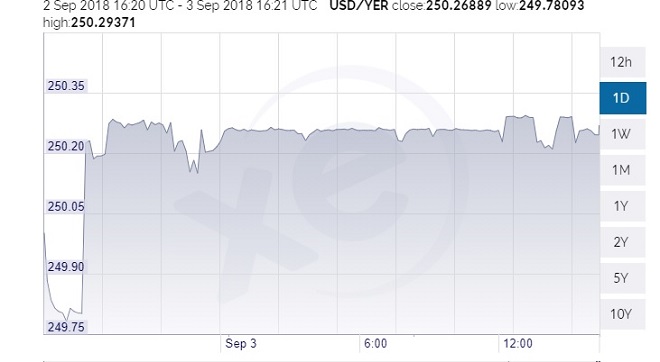
Unlike most Middle-eastern countries, the Yemen rial is a free-floating currency, albeit with low liquidity. The decision to float the currency was made in August last year, and up until then, 250 rials were equal to one US dollar in the legal currency market.
Due to the lack of liquidity and the ongoing civil war, most Forex brokers do not permit trading in the currency, and the price chart mostly shows the exchange rate to be 250 rials to the dollar. However, most transactions happen in the black market, wherein the rial hovers around the 600 mark.
Disclaimer: Any financial trading analysis offered here is our opinion and is not intended as advice or direction for investors. We cannot guarantee the success of any trades made as a consequence of this article, and we encourage traders to incorporate a strong money management strategy to limit losses when they enter the markets. Please use this article as part of your own research before formulating strategies prior to trading.